
Why you need a crypto tax calculator (and why Excel isn’t enough)
50+ transactions across 3 platforms, daily BNR exchange rates, FIFO, swaps reported via DAC-8. Why manually calculating crypto taxes in Excel fails, and what an automated calculator does.
Let’s take a perfectly ordinary investor. Let’s call him Andrei. In 2026, Andrei used three platforms: a major international exchange, a local one for withdrawals in lei, and a crypto card app for day-to-day payments. In total, around 60 transactions: a few purchases, lots of swaps, a few sales in euros, and about twenty card payments.
Andrei isn’t a professional trader. He’s the sort of person who says to himself, “I’ll just pop them into an Excel spreadsheet over the weekend.” Then he opens the first CSV file, and that one weekend turns into three.
Where Excel breaks down, step by step
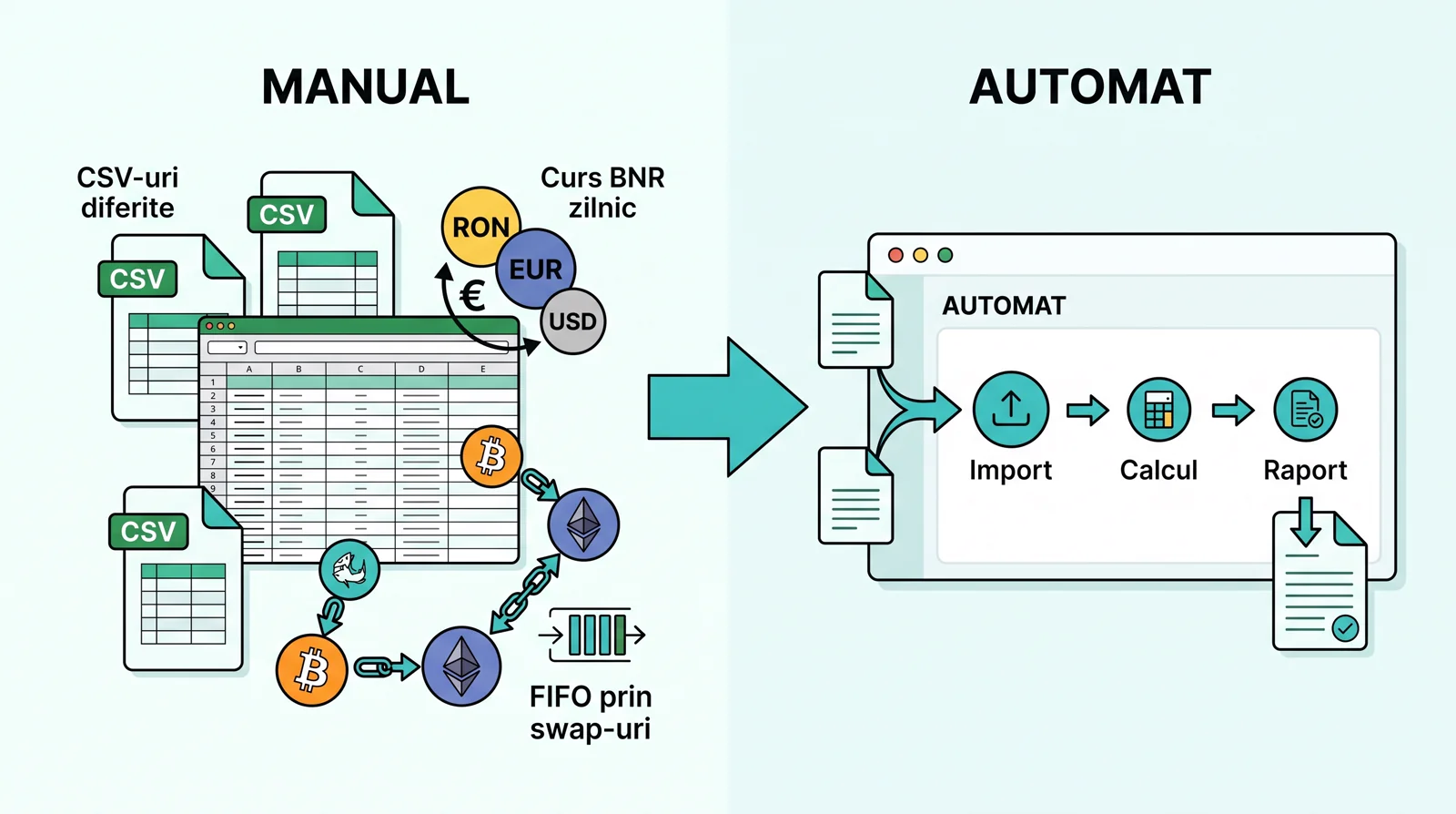
Different formats. Each platform exports data differently: different columns, different labels, different time zones, different date formats. The first step isn’t the calculation, but hours spent manually cleaning and aligning the data. And any error in the alignment carries through into everything that follows.
The BNR exchange rate, daily. Sales in euros or dollars are valued in lei at the BNR exchange rate on the day of each transaction. For 60 transactions spread throughout the year, this means dozens of manual searches for historical exchange rates and just as many opportunities to get the date or a decimal place wrong.
Tracking costs via swaps. This is where most manual calculations fall short. Swaps are not subject to tax, but the acquisition cost is carried over from one currency to another with every swap. Bitcoin bought for 200,000 lei, exchanged for Ethereum, then partly for Solana, sold in tranches: which tranche carries which cost? The FIFO method requires batch-by-batch tracking of each purchase, and in Excel this means formulas that few people can construct correctly and almost no one can verify.
Rounding errors. Quantities with eight decimal places, prices with four, hundreds of lines. Small rounding differences add up, and in the end your figure no longer matches the platform’s statement. And from 15 March 2027, the ANAF will compare your tax return with the platform’s figures exactly, via the automatic DAC-8 reporting system.
Lack of an audit trail. Perhaps the most underestimated point. During an audit, it is not enough to simply present a final figure: you must be able to show how you arrived at it, transaction by transaction. A personal Excel spreadsheet, with formulas that have been altered along the way, is difficult to defend. Supporting documents must be kept for five years, and the calculation must be reproducible throughout this period.
What, exactly, does a vending machine do?
Different formats on each platform - Import transactions from Binance and hundreds of other exchanges and wallets
Exchange rate looked up manually for each day - Automatic conversion at the BNR rate on the date of each transaction
Purchase cost lost through swaps - FIFO tracking by batch, across all shifts
Figures that cannot be verified - Final report detailing each transaction, ready for archiving
Hours or days worked - Minutes, from the imported figure to the amount to be entered in the Declarația Unică
The result is a crypto tax calculation based on Romanian rules, not US or German ones: the correct annual net income, which you enter under cod 1023 in Declarația Unică. Plus a detailed report documenting every step - exactly the insurance policy you’ll need in the event of an audit.
Why education remains the other half
A computer handles the maths. But the decisions are still up to you: which transactions constitute taxable events, how to treat staking rewards with a zero acquisition cost, what to do with an airdrop, when mining becomes an economic activity, and how to respond if the ANAF asks for an explanation. The rules have changed significantly over the last two years (the 16 per cent tax rate, DAC-8, automatic reporting) and will continue to change.
That’s why the platform and the course go hand in hand: the app gives you the figures, the course gives you the insight. With both, you won’t be relying on anyone in May.
Andrei’s case, taken through to the end
Let’s put some figures to the scenario outlined at the start. Andrei imports the three CSV files. The application identifies 22 card payments (all of which are taxable events that his Excel spreadsheet would almost certainly have missed), 9 sales in euros converted at the correct BNR exchange rate for each day, and 27 swaps excluded from taxation in accordance with the general interpretation in Romania, but with the acquisition cost carried forward on a FIFO basis.
Final figure: a net income of 41,810 lei. 16 per cent tax: 6,689 lei. CASS, first bracket: 2,430 lei. Total payable: 9,119 lei, with every leu accounted for, transaction by transaction.
Andrei’s time: under an hour, instead of three weekends. And, more importantly, a statement that will match the report his platforms send to ANAF.
Frequently Asked Questions
Can't I just do the calculations myself in Excel?
You can, with a small volume: a few simple buys and sells, without swaps, on a single platform. Once you exceed 20-30 transactions or upon the first chain swap, the risk of error rises rapidly, and your figures must stand up to scrutiny when compared with DAC-8 reporting.
Does the app work on the platforms I use?
The import function covers hundreds of exchanges and wallets, ranging from the largest international ones to local platforms. The full list is available in the app.
Does the calculator submit the tax return for me as well?
No, and no reputable application does this: the Single Tax Return must be submitted in person, via your SPV account. The calculator gives you the correct amount to enter under cod 1023 and the report that supports it.
What calculation method does it use?
FIFO, the de facto standard for batch-based record-keeping, is the easiest to substantiate with documentation during an audit.
You can start with either of the two resources. The Crypto Support app for automatic calculations, or the video course From Crypto to ANAF, 2026 edition to understand every rule behind the figures, verified by CECCAR accountants. Together, they cover the entire process from the first CSV file to the submitted tax return.
Content verified by CECCAR-certified accountants. This information is for educational purposes only and is not a substitute for personalised tax advice.
Need your own tax report?
Import your transactions and get the figures for the Unique Declaration, calculated by ANAF rules.
Read next
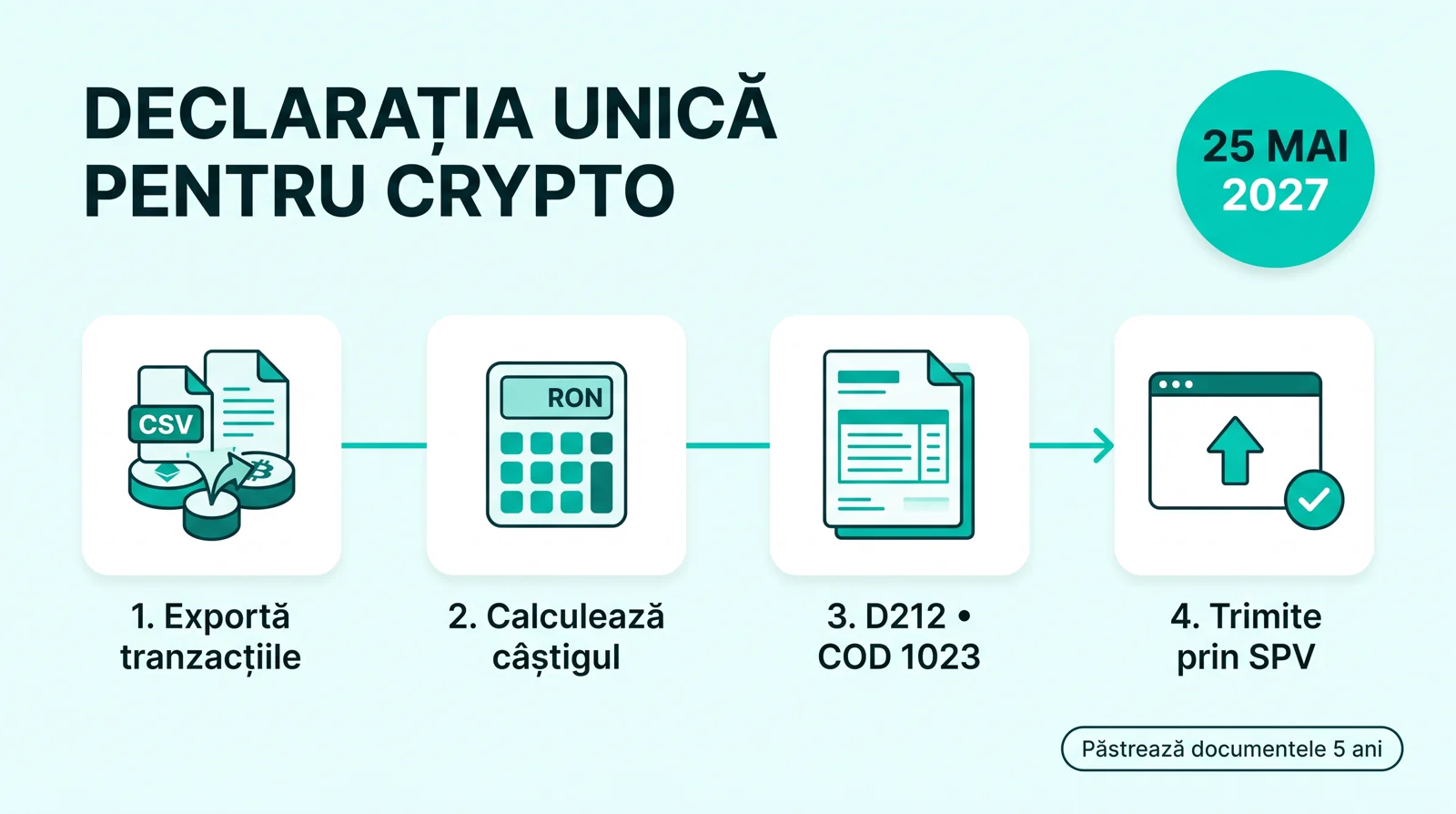
Declarația Unică pentru crypto: what you need to know before completing formularul 212
How to declare cryptocurrency to ANAF via the Declarația Unică: what documents to prepare, codul de venit 1023, the 25 May deadline, the 3 per cent discount, and what you risk if you fail to declare it.
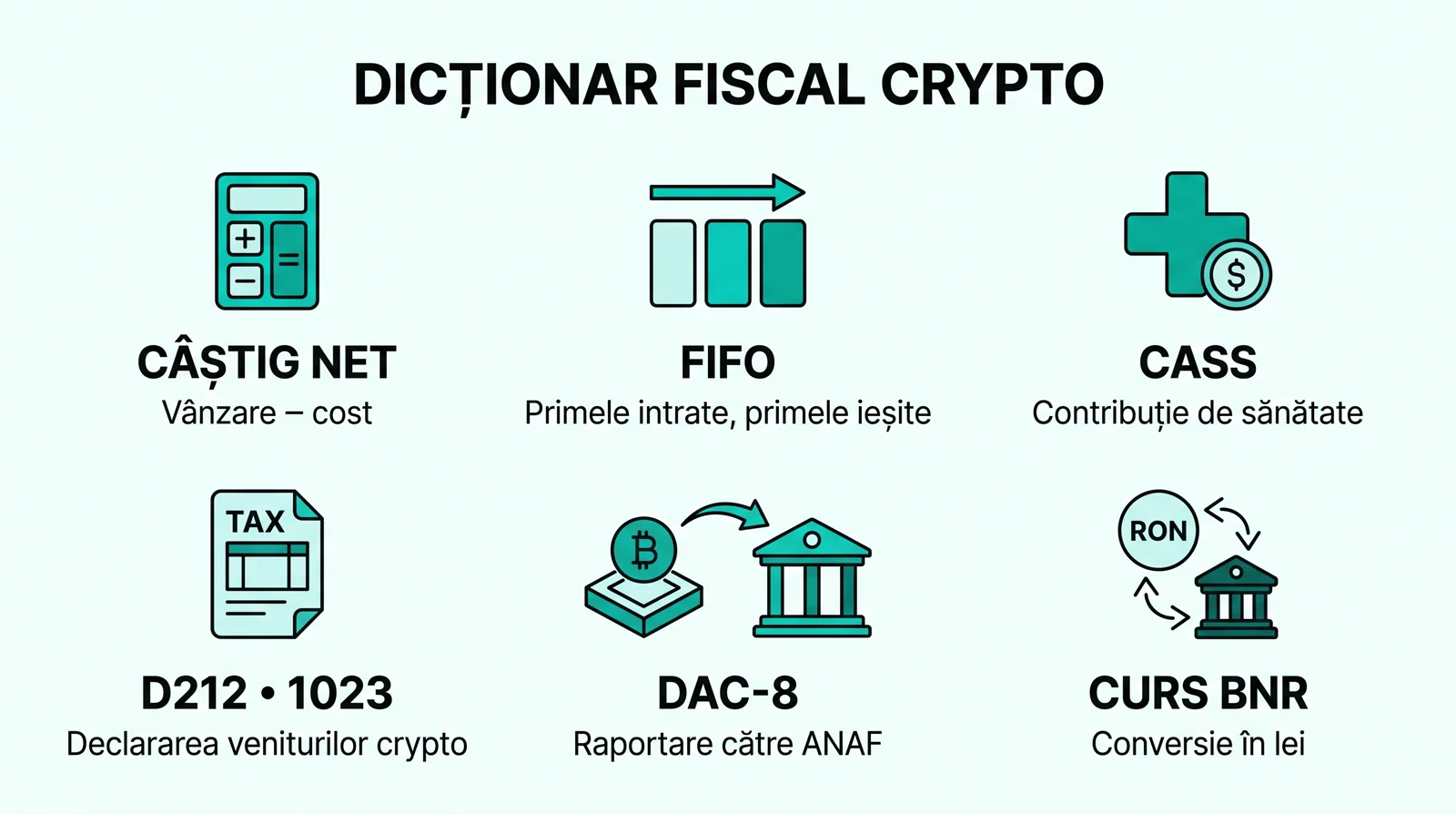
FIFO, CASS, DAC-8: A glossary of crypto tax terms for Romania
What do FIFO, CASS, DAC-8, cod 1023 and ‘tax event’ mean? A comprehensive glossary of crypto tax terms for Romania, explained in a way that investors can understand.
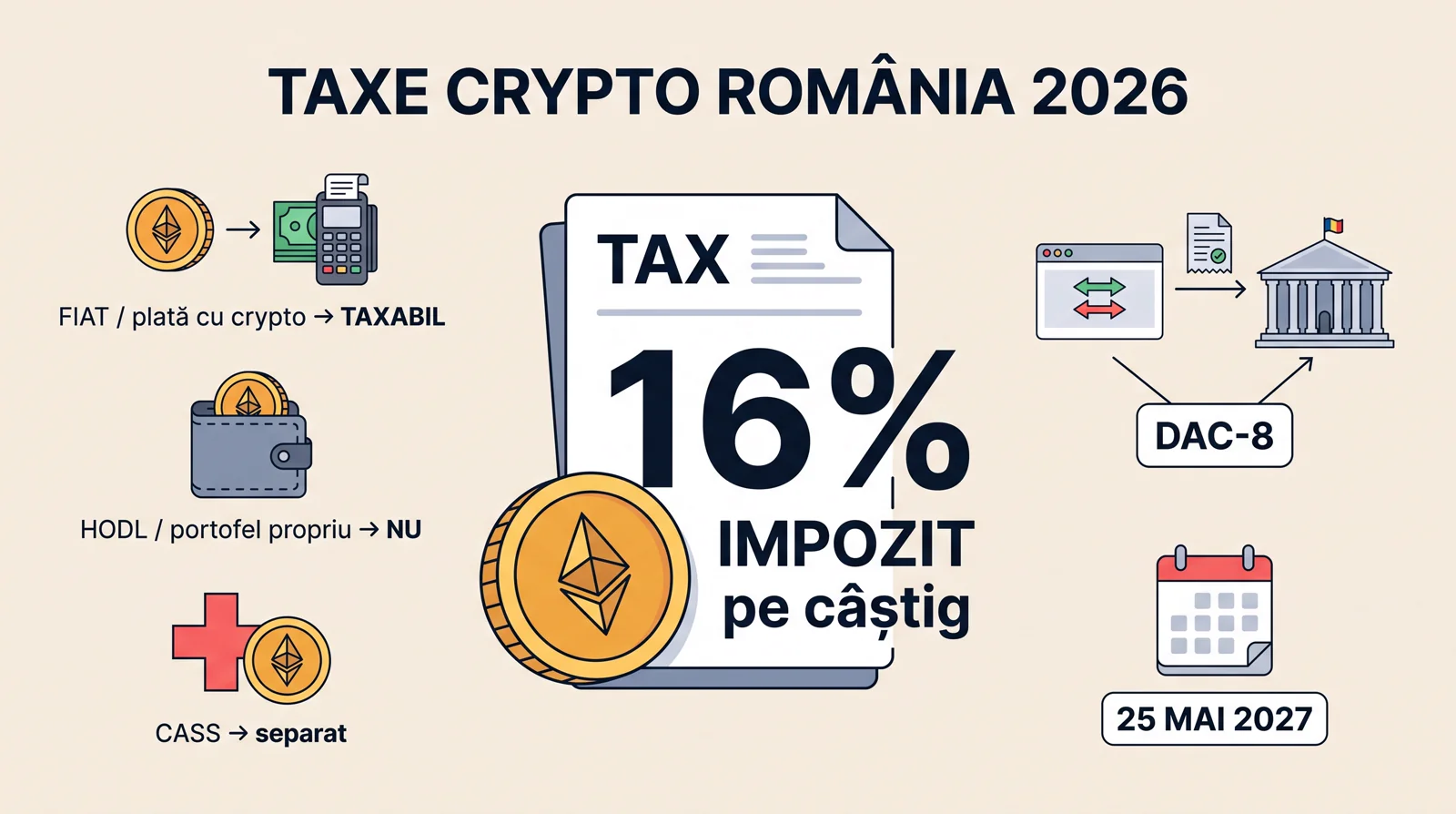
Crypto Taxes in Romania 2026: the complete guide for investors
How much do you pay in tax on crypto gains in Romania: a 16 per cent tax from 2026, a progressive health insurance contribution (CASS), exemption thresholds, a deadline of 25 May and automatic DAC-8 reporting.