
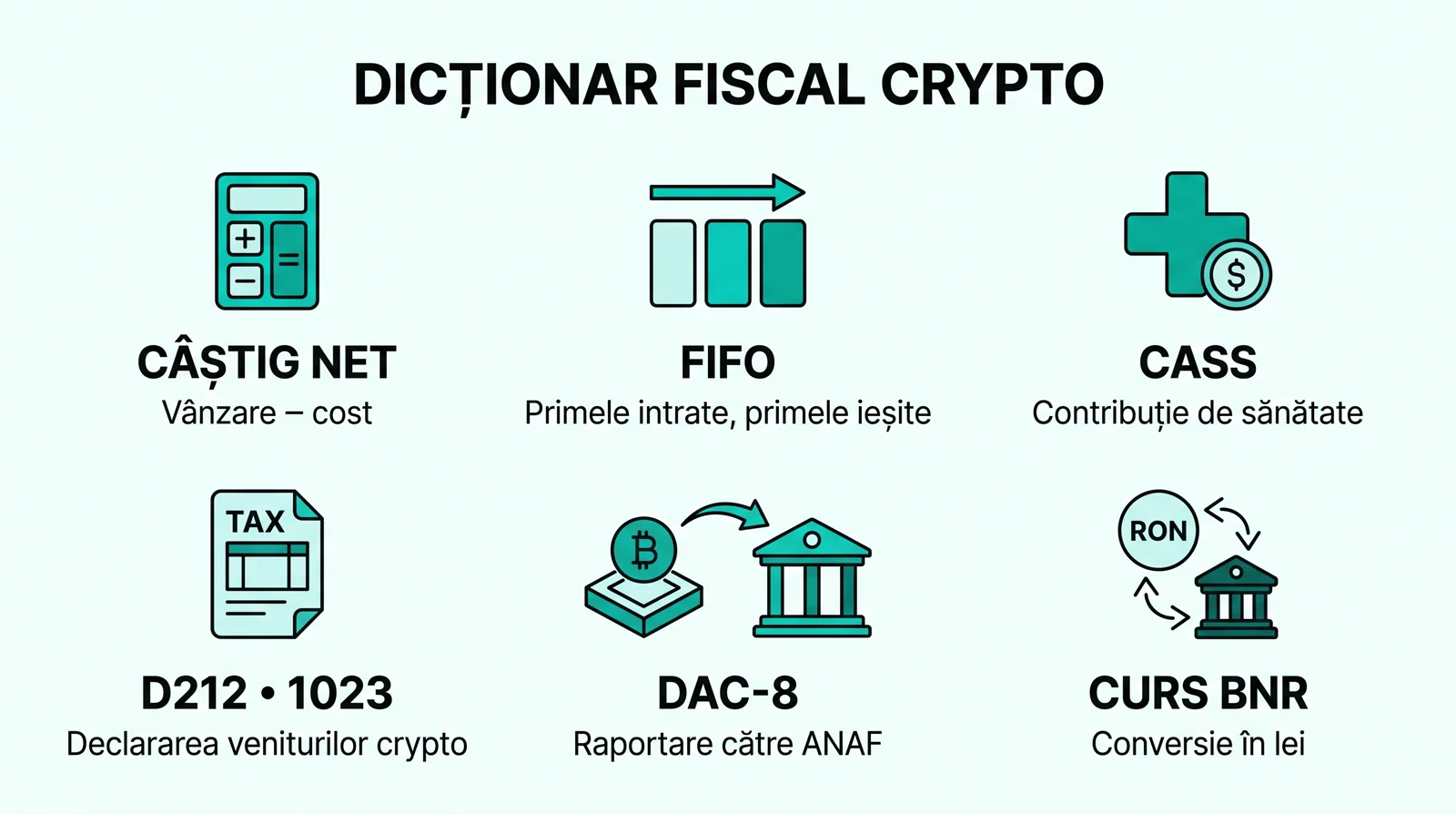
FIFO, CASS, DAC-8: A glossary of crypto tax terms for Romania
What do FIFO, CASS, DAC-8, cod 1023 and ‘tax event’ mean? A comprehensive glossary of crypto tax terms for Romania, explained in a way that investors can understand.
If you’ve ever read an article about crypto taxes and ended up with more questions than you started with, it’s not your fault. Taxation has its own language, and when you combine it with crypto terminology, the result can seem incomprehensible. This glossary explains the terms you’ll come across most often when declaring your earnings to ANAF, each in a strictly Romanian context.
You can skip straight to the term you’re interested in. Each section is independent.
Article 116 of the Tax Code
The legal basis for crypto taxation in Romania. Gains from the transfer of virtual currency are classified under the category ‘income from other sources’, and tax is levied on the positive difference between the sale price and the purchase cost. Crypto taxation is not a grey area: everything is set out in black and white in this section of the law.
The 16 per cent tax
The income tax rate applicable to crypto gains realised from 1 January 2026, introduced by Law 239/2025. For gains made in 2025, the old rate of 10 per cent applies. The jump from 10 per cent to 16 per cent means, in real terms, taxes that are 60 per cent higher than in previous years.
Tax event
The point at which the obligation to calculate and declare a gain arises. Under current practice in Romania, taxable events include: the sale of cryptocurrency for lei or another fiat currency, and payment with cryptocurrency for goods or services, including a coffee paid for with a crypto card. The following are not taxable events: buying cryptocurrency with lei, holding it for the long term, and transferring funds between one’s own wallets. Crypto-to-crypto swaps are a grey area: the general interpretation is that they are not taxable, but in the absence of official guidance from ANAF, some treat them cautiously as taxable events.
Net profit
The positive difference between the selling price and the purchase price of a cryptocurrency. Tax is levied on this amount. Important: the law only takes into account positive differences, per transaction.
Acquisition cost (cost basis)
In international crypto terminology, this is known as the ‘cost basis’. It is the amount originally paid for a cryptocurrency, expressed in lei. It is the figure from which any calculation of profit is based. The key rule: the acquisition cost follows you through all subsequent trades; it is not reset with every swap. For cryptocurrency received for free (via staking, airdrops or as a gift), the acquisition cost is zero, so upon sale the entire amount received is a taxable profit. How to correctly track the cost through a chain of swaps, with examples using figures, is one of the central topics of the course.
FIFO (First In, First Out)
The FIFO method of calculating acquisition cost: the first coins purchased are treated as the first to be sold. This is the standard method used by tax calculation software and the easiest to substantiate with supporting documents in the event of an audit. Please note: Romanian legislation does not expressly require a specific method, but it does require a correct and documented calculation for each transaction, and FIFO is the practical solution for this.
Crypto-to-crypto swap
A direct swap between two cryptocurrencies, for example Bitcoin for Ethereum. Is a crypto swap taxable? The general interpretation in Romania is that the swap itself does not give rise to tax, a minority view in Europe, similar to that in France. However, it is important to note that ANAF has not yet published official guidance specifically on swaps, so the subject remains a grey area, and some taxpayers prefer to take a conservative approach and treat each swap as a sale for tax purposes. Regardless of the option chosen, two things remain true: the initial acquisition cost is transferred to the currency received, and trading platforms report each swap as a sale plus a purchase, both valued in lei at the time of the transaction. The tax authorities see it all.
Declarația Unică (Formularul 212 / D212)
The form used by individuals to declare their income, including income from cryptocurrency. It is completed directly on the ANAF website, via Spațiul Privat Virtual. Crypto earnings are declared under codul de venit 1023, and the deadline for submission and payment is 25 May of the year following that in which the earnings were realised.
Cod 1023
The specific income code for virtual currency transfers in the Declarația Unică. All crypto income must be declared here, regardless of whether the platform is based in Romania or abroad. Declaring this income under a different code - for example, as dividends - will result in the form being automatically rejected.
SPV (Spațiul Privat Virtual)
Each taxpayer’s official online account on the ANAF website. This is where you submit the Declarația Unică, receive notifications from the tax authorities and check your payment obligations. Without an SPV account, it is not possible to submit your tax return online, and setting up the account can take a few days, so don’t leave it until the last minute.
CASS (Health Insurance Contribution)
Health insurance contributions due on crypto income. This is not a percentage of earnings, but a fixed amount set across three income brackets, with a maximum ceiling of 9,720 lei, regardless of how high the earnings are. Being placed in the correct bracket depends on several factors, including whether or not you have other taxable income, and this is where many calculation errors occur. The full mechanism, including all exceptions, is covered in a dedicated chapter of the course ‘From Crypto to ANAF’.
CAS (Pension contribution)
For income from cryptocurrency, the pension contribution is zero. Cryptocurrency gains are not regarded as income from employment, so they generate neither a payment obligation nor pension entitlements. This is one of the few genuine tax advantages of this category of income.
Exemption thresholds: 200 and 600 lei
The only exemption provided for by law for cryptocurrency. Cumulative conditions: each gain per transaction must be less than 200 lei AND the total gains for the year must be less than 600 lei. Both conditions must be met simultaneously, and this is where many people miss out on the exemption without realising it, because the threshold does not work as most people expect. We’ll break down the exact pitfalls in this course, with examples.
Tax loss
The negative difference between the selling price and the purchase cost. Important point: there is no section for crypto losses on the Declarația Unică, so losses cannot be deducted from gains nor carried forward to subsequent years. Only the total amount of gains is declared; transactions resulting in a loss remain in your personal records.
DAC-8
DAC-8 (sometimes written as DAC8) is European Directive 2023/2226, transposed into Romanian law by OUG 71/2025, which requires all crypto platforms to automatically report their customers’ transactions to ANAF. The platforms will collect data from 1 January 2026, and the first full report will be submitted to ANAF on 15 March 2027, covering all activity in 2026. In practice, the tax authorities will compare the platform’s report with your tax return, figure by figure.
CARF (Crypto-Asset Reporting Framework)
The OECD global standard on which DAC-8 is based. It extends the automatic exchange of tax information worldwide, meaning that even platforms outside the European Union will not remain outside the reporting system in the long term.
The 3 per cent bonus
Measure introduced by OUG 8/2026: a 3 per cent reduction in income tax for those who submitted the Declarația Unică and paid their tax liabilities in full in respect of income earned in 2025 by 15 April 2026. The reduction applied only to income tax, not to health insurance contributions. The deadline for 2025 income has passed, but the scheme may be repeated for the 2027 tax return, so it is worth keeping an eye on the tax calendar this spring.
Staking
Staking cryptocurrencies to support a blockchain network, in exchange for periodic rewards. How is tax applied to staking in Romania? For tax purposes, the rewards are not taxed upon receipt, but have a zero acquisition cost: when you sell them for lei, the entire amount received is taxable income, subject to 16 per cent tax.
Airdrop
Cryptocurrencies received free of charge, usually for promotional purposes. Treated in the same way as staking: not taxable on receipt, zero cost basis, tax payable on the full amount upon sale. The relevant date for record-keeping purposes is the day on which you claim the tokens or gain control over them.
Mining
Validating blockchain transactions in exchange for rewards. As an occasional hobby, it is similar to staking. However, if the income becomes regular and substantial, the activity may be regarded as a business, requiring registration as a sole trader (PFA) or a SRL, each with a completely different tax regime. For recurring income of tens of thousands of lei per year, consulting a tax adviser becomes essential.
NFTs and the 40 per cent deduction
For NFT creators, income from sales may be classified as intellectual property rights, with a flat-rate deduction of 40 per cent: the state automatically treats part of the price as expenses, without the need for supporting documents - a major tax advantage that NFT traders do not enjoy. Please note: purchasing an NFT with cryptocurrency is in itself a taxable event. The difference between the creator and trader regimes, along with the relevant calculations, is covered in the chapter on NFTs in the course.
BNR exchange rate
The official exchange rate of the National Bank of Romania, used to convert transactions made in foreign currency or valued in foreign currency into lei. Each transaction is valued at the exchange rate on the day in question, which is one of the reasons why manual calculation in Excel quickly becomes impractical when dealing with dozens of transactions.
Amended declaration
The official procedure through which you can voluntarily correct tax returns from previous years. You pay the tax due and any interest accrued, but avoid the penalty for failure to file, which is the most costly of all. If you have undeclared income from previous years, this is the legal way to settle the matter.
Frequently Asked Questions
Is the FIFO method mandatory for cryptocurrency in Romania?
There is no legal provision requiring a specific method. FIFO is the standard method used in accounting software and the easiest to document in the event of an audit. What ANAF requires is a correct calculation for each transaction, supported by documentation.
Are crypto losses deducted from gains?
No. The Declarația Unică form does not have a section for crypto losses. Only the amount of gains is to be declared.
Is crypto trading subject to tax in Romania?
The general view is that it does not, but in the absence of official guidance from ANAF, the matter remains a grey area, and some prefer to tax swaps as well, as a precautionary measure. What is certain is that the acquisition cost is transferred to the currency received and that the platforms report each swap to ANAF via DAC-8.
How much is the CASS for crypto?
A fixed amount in tiers: 2,430, 4,860 or 9,720 lei, depending on the annual net income. It is not a percentage of income, and the maximum limit is 9,720 lei.
The terms are just the beginning. You can find out how they all fit together in practical, step-by-step calculations - with all the pitfalls highlighted - in the video course From Crypto to ANAF, 2026 edition, verified by CECCAR accountants. And if you want the calculation done automatically, with data imported directly from exchanges and converted at the BNR exchange rate, The Crypto Support app does exactly that.
Content verified by CECCAR-certified accountants. This information is for educational purposes only and is not a substitute for personalised tax advice.
Need your own tax report?
Import your transactions and get the figures for the Unique Declaration, calculated by ANAF rules.
Read next
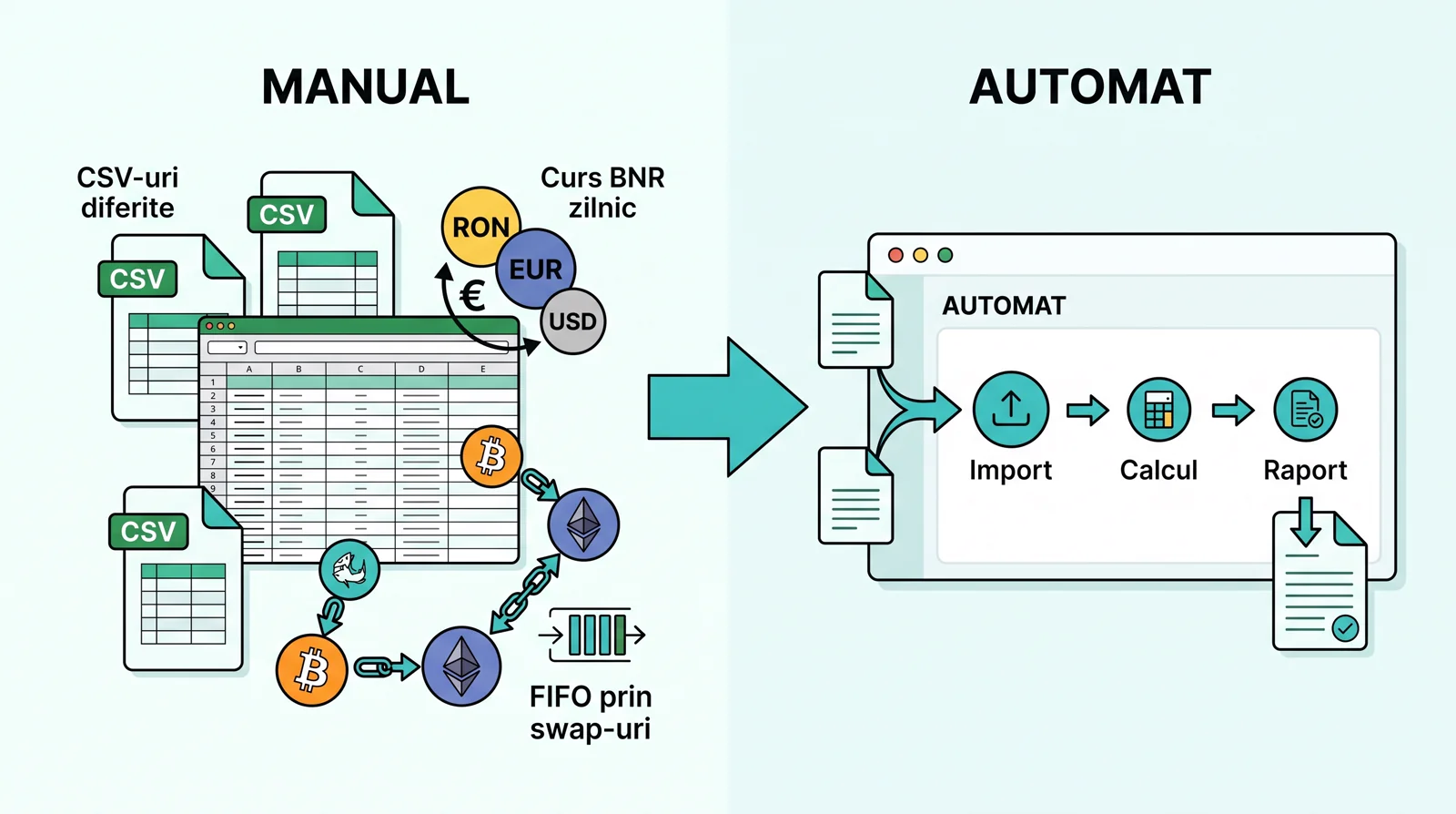
Why you need a crypto tax calculator (and why Excel isn’t enough)
50+ transactions across 3 platforms, daily BNR exchange rates, FIFO, swaps reported via DAC-8. Why manually calculating crypto taxes in Excel fails, and what an automated calculator does.
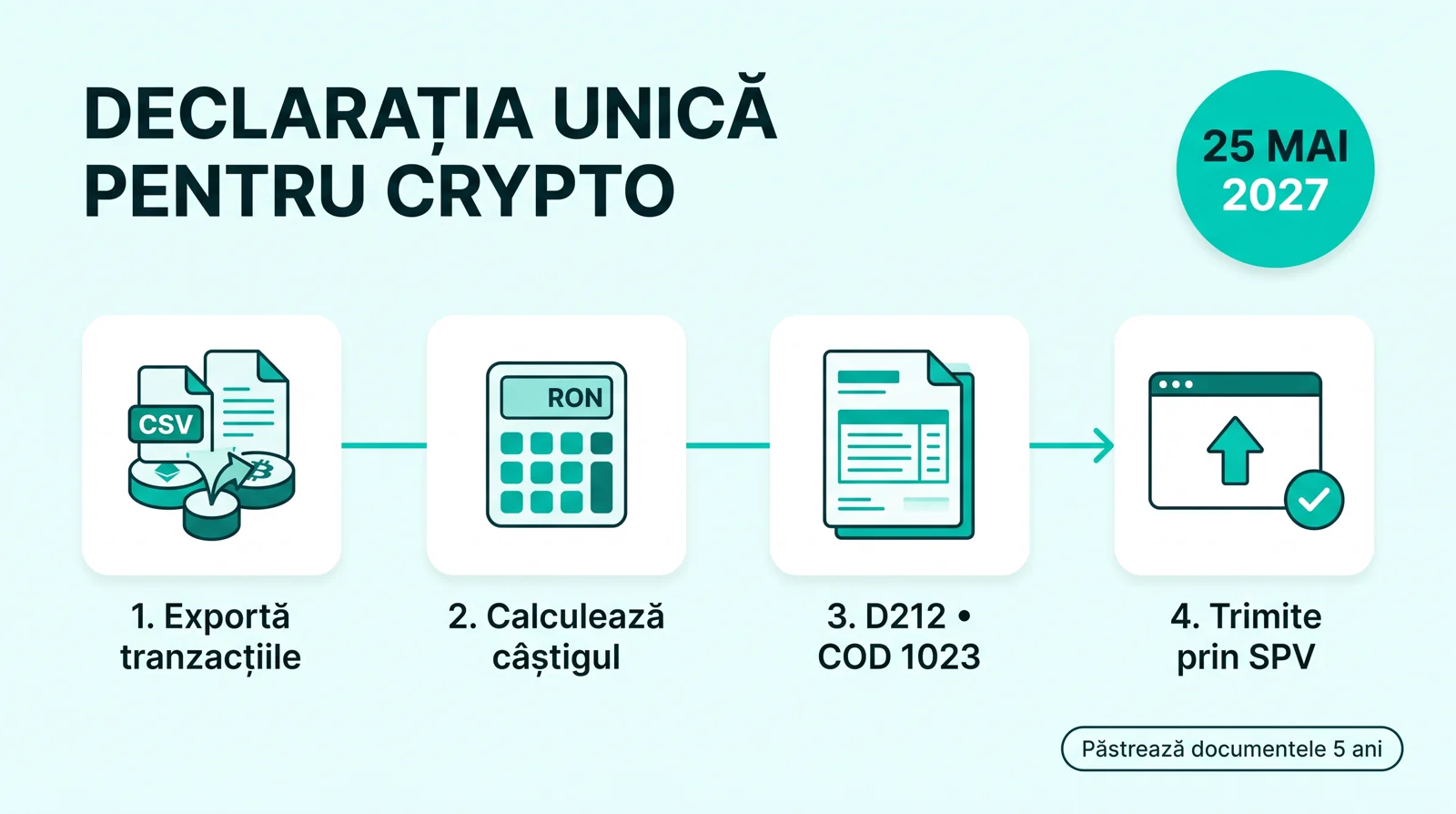
Declarația Unică pentru crypto: what you need to know before completing formularul 212
How to declare cryptocurrency to ANAF via the Declarația Unică: what documents to prepare, codul de venit 1023, the 25 May deadline, the 3 per cent discount, and what you risk if you fail to declare it.
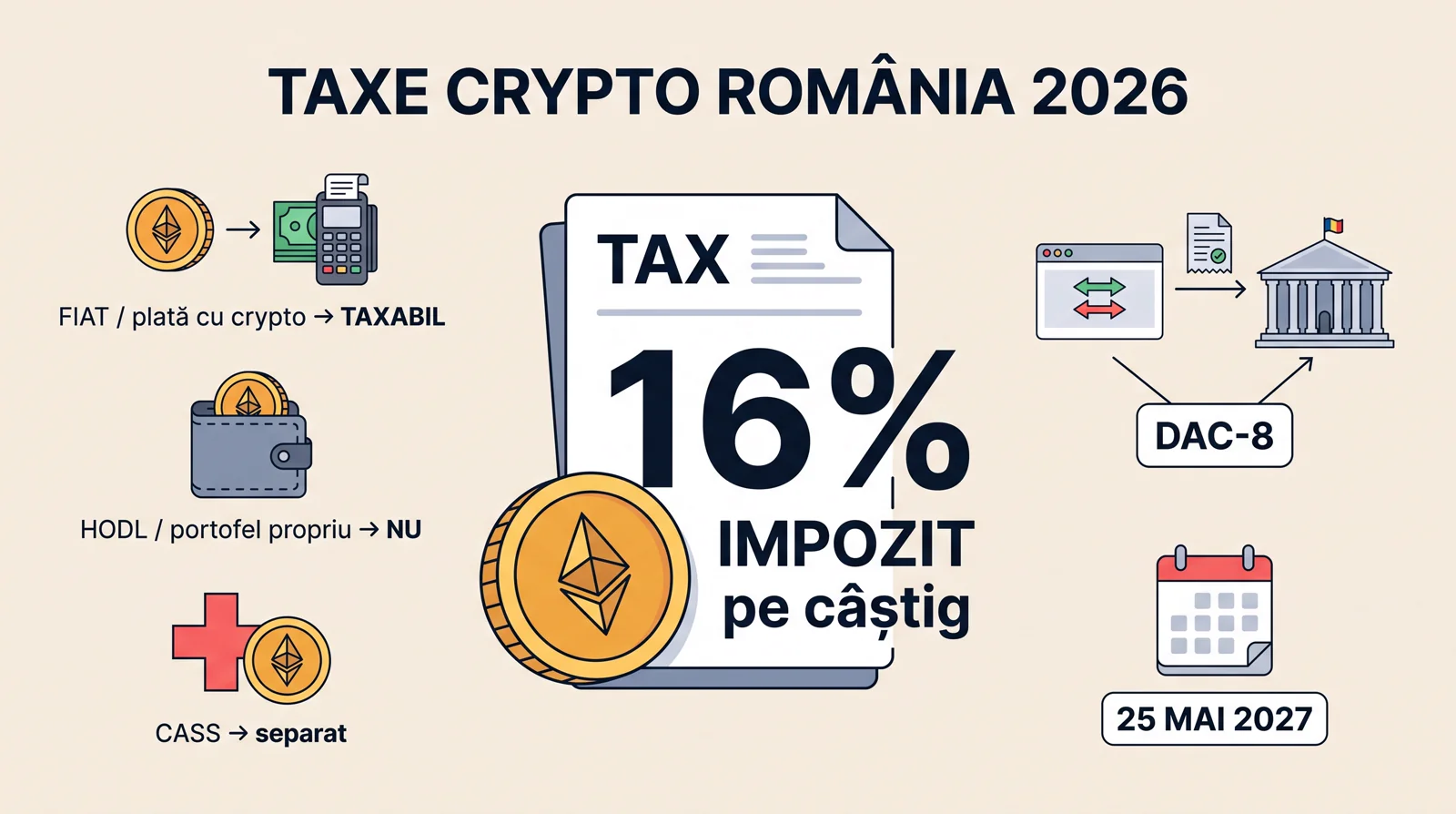
Crypto Taxes in Romania 2026: the complete guide for investors
How much do you pay in tax on crypto gains in Romania: a 16 per cent tax from 2026, a progressive health insurance contribution (CASS), exemption thresholds, a deadline of 25 May and automatic DAC-8 reporting.