
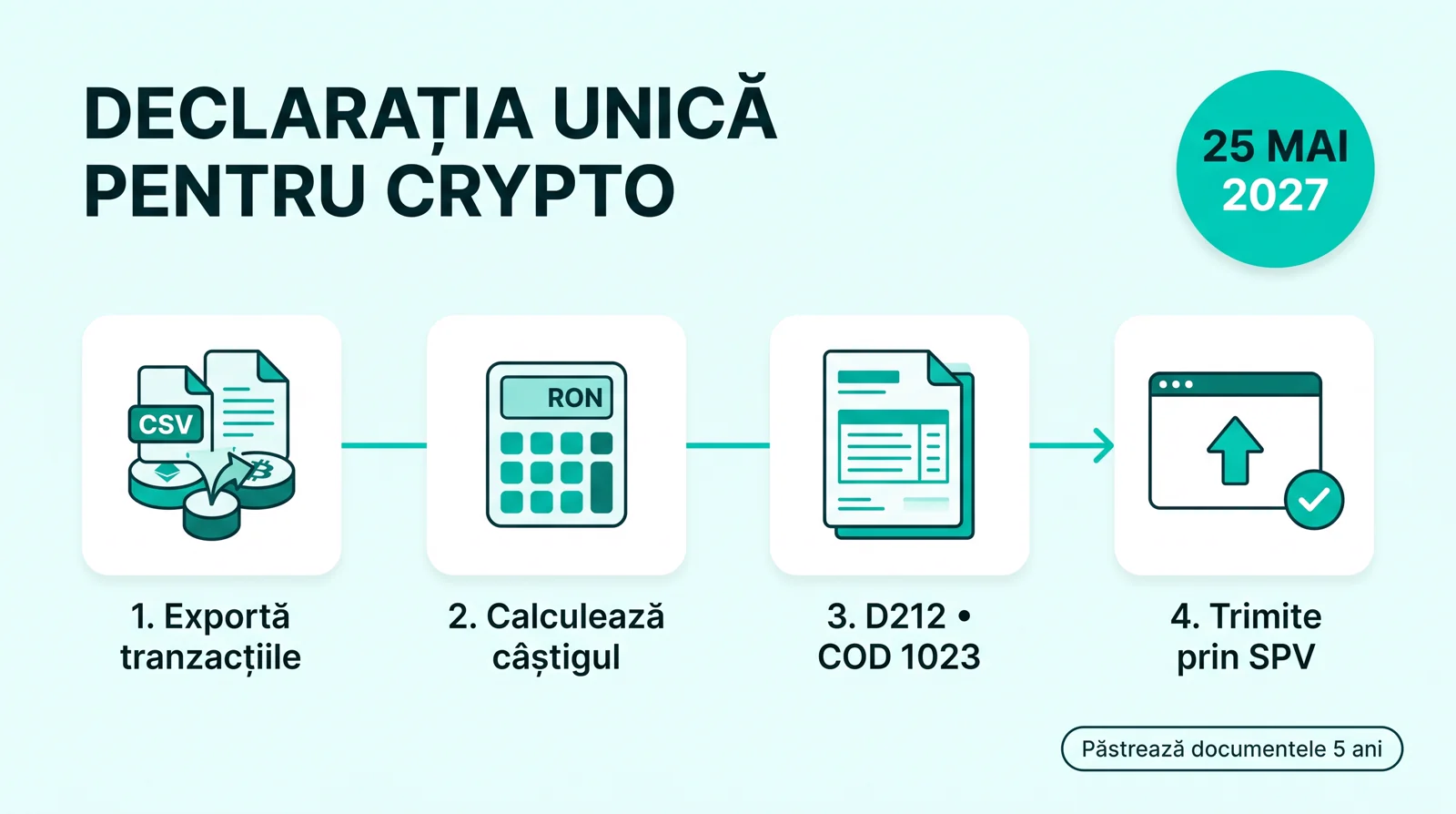
Declarația Unică pentru crypto: what you need to know before completing formularul 212
How to declare crypto to ANAF in the Declarația Unică: documents, codes 1023 and 2014, the 25 May deadline, the 3% discount and the risk of not filing.
Methodology reviewed with CECCAR chartered accountants.
Crypto gains made in 2026 are declared in the Declarația Unică (formularul 212), through SPV, by 25 May 2027, which is also the payment deadline. Cod 1023 is for Romanian platforms and your own wallet, cod 2014 for foreign ones, one entry per country. The rate is 16%, under Article 116 of the Tax Code and Law 239/2025.
You know you have to declare it. The question is how: what documents you need to prepare, exactly where on the form to enter your crypto earnings, which deadlines apply, and what happens if you miss them. This guide covers exactly that part of the process, from exporting your first CSV file right through to the moment you click ‘Submit’.
Let’s make one thing clear from the outset: formularul 212 does not calculate your profit for you. Declarația Unică simply takes a single final figure - your annual net income - which you must have calculated correctly beforehand. Everything that follows is based on this fact.
Step zero: the SPV account
The tax return is submitted online via the Spațiul Privat Virtual on the ANAF website. If you don’t have an account, set one up in good time: the identity verification process can take a few days, and in May, when everyone is mindful of deadlines, any delay can be stressful.
What documents do you need to prepare?
Before you open the form, you will need three types of documents:
1. Complete transaction history. Export the CSV files from every platform where you’ve carried out transactions: exchanges, crypto card payment apps, staking platforms. All of them, including those you’ve only used once. Under DAC-8, each of these platforms reports to ANAF, so your records must cover everything they report.
2. Calculation of gains. For each sale in fiat currency and each payment in cryptocurrency: sale price minus acquisition cost, valued in lei on the date of the transaction, with conversion at the BNR exchange rate on that day for transactions in foreign currency. Swaps, according to the general interpretation, are not taxable (although, in the absence of official guidance from ANAF, they remain a grey area), but they must still be recorded in order to track the acquisition cost.
To be honest, this is the part that stumps most people. With dozens of transactions across multiple platforms, using different export formats, the BNR exchange rate looked up for each day and acquisition costs carried through swaps, manual calculation becomes extremely difficult to get right and almost impossible to verify. That’s exactly why Taxes Support exists: it imports transactions directly from your platforms, automatically converts them at the BNR exchange rate, and calculates the final amount to be included in your tax return, complete with a detailed report to back it up.
3. Proof of purchase. Purchase receipts, bank statements, deposit history. Without proof of the purchase price, the tax authorities may, during an audit, assume the cost to be zero and tax the entire amount received.
All documents must be kept for at least 5 years. Think of them as an insurance policy: without them, any calculation, however accurate, remains an unsubstantiated opinion.
The annual calendar
January-March - The form for the previous tax year becomes available in SPV; for the 2026 Declarația Unică, ANAF has, for the first time, also provided a pre-filled version
15 April - Deadline for the tax relief, where applicable (in 2026: a 3 per cent reduction in income tax, under OUG 8/2026, for returns filed and payments made in full by this date)
1-25 May - Standard submission period
25 May - Strict deadline for both submission AND payment
For earnings in 2026, the deadline is 25 May 2027. The 3 per cent bonus was introduced for the first time in 2026 and applied only to income tax, not to health insurance contributions; if the scheme is repeated for 2027, the deadline to note will again be mid-April.
Where to enter ‘crypto’ on the form: codes 1023 and 2014
The code depends on where you realised the gain, that is, on the country of the company operating the platform you contracted with, not on where the app or the coin comes from:
Cod 1023, in the section on income earned in Romania: income from other sources, from the transfer of virtual currency. This covers gains on platforms established in Romania and gains from your own wallet, where there is no company in another country.
Cod 2014, in the section on income earned abroad: ‘Alte venituri’. The foreign side of the form has no separate category for crypto, so gains on Binance, Coinbase, Kraken, Bybit and the other platforms established outside Romania go here.
Under cod 2014 you add one entry per country, with the annual gain from that country: two platforms in the same state are a single entry. The country is that of the entity you dealt with on the date of the transaction, and some platforms moved Romanian clients between entities in different countries in 2025, as MiCA licences came through. The rate is the same, 16% for 2026 gains, and so are the 200 and 600 lei thresholds. The legal basis: Article 116 of the Tax Code for the income and Law 239/2025 for the 16% rate.
The form takes the amount you have calculated and adds the tax and the health insurance contribution on that basis. This is where the most common surprise comes in: many people expect to pay only tax and then discover that the total also includes the health insurance contribution (CASS), a fixed amount per tax bracket that can reach 9,720 lei. Correct classification into tax brackets, including all exceptions, is covered in the chapter on contributions in the course.
Procedural errors we see time and time again: declaring gains from foreign platforms under cod 1023 instead of cod 2014 in the foreign income section, omitting payments made by crypto card (these are sales and must be declared), attempting to calculate profit directly on the form, and failing to keep supporting documents.
What happens if you don’t declare it?
The fine for failing to submit the declaration ranges from 50 to 500 lei. That sounds manageable, but it’s just the tip of the iceberg. The real cost comes from elsewhere:
Recalculated tax. Without your supporting documents, the tax authorities may apply the zero acquisition cost rule: tax is levied on the full amount received, not on the profit.
Additional charges. Interest on arrears plus a late payment penalty, both of which accrue on a daily basis.
Penalty for failure to declare. The most severe penalty, imposed following an audit.
A gain declared voluntarily costs the tax and the CASS; undeclared and uncovered during an audit, it can cost nearly three times as much. And with the DAC-8 automatic reporting system, detection is only a matter of time: on 15 March 2027, ANAF will receive the full report of activity for 2026 from all platforms and compare it with each individual’s tax return.
If you have previous years’ undeclared income, the legal solution is to file the return for each year as soon as possible, or an amended return if you filed one without that income: you voluntarily correct the error, pay the tax and interest, but avoid the penalty for non-declaration. It’s the smartest way to put an end to a problematic situation.
Final check before sending
Before submission, the return must undergo a systematic check: the treatment of swaps, crypto card payments, the CASS tier, the income code, and archived documents. Any point missed is a potential discrepancy compared with the report that the platforms submit to ANAF.
You can find the complete, step-by-step safety checklist, plus a practical guide to completing the form with explanations of all the fields, in the chapter dedicated to the Declarația Unică in the course Profit Crypto fără Bătăi de Cap.
Frequently Asked Questions
Can I submit the Declarația Unică on paper?
The rule of thumb is to submit your return online via SPV. You’ll need an SPV account to communicate with ANAF anyway, so set one up in good time.
Does the form calculate my tax for me?
Partly. You enter your annual net income, which you have calculated in advance, and the system automatically applies the tax and health insurance contribution. You remain fully responsible for calculating your earnings.
Which exchange rate should I use for transactions in euros or dollars?
The BNR exchange rate on the day of each transaction. When dealing with tens or hundreds of transactions, it is precisely this detail that makes manual calculation impractical.
I forgot to file my tax return for a year. What should I do?
File it now, late; if you filed it but left income out, submit an amended return. Pay the tax and interest, but avoid the penalty for failure to file. The sooner you do this, the fewer additional charges you’ll incur.
Do swaps have to be reported as well?
According to the general interpretation, swaps do not give rise to tax, so they are not included in the declared amount. Please note, however, that ANAF has not published any official guidance on this matter, so it remains a grey area, and some taxpayers prefer to include them in their calculations as a precautionary measure. In any case, trading platforms report them, and you need to keep a record of them to document the acquisition cost of the coins you subsequently sell.
That concludes the section on background information and documents. For the figure you enter into the form, Taxes Support performs the calculations automatically - a process that takes just a few minutes rather than days spent in Excel - and the crypto tax calculator gives you a first estimate. We walk you through the actual process of completing the form, field by field, with screenshots and all the special scenarios, in the video course Profit Crypto fără Bătăi de Cap, 2026 edition, verified by chartered accountants who are CECCAR members. And if your situation is already complicated, there is one-to-one tax assistance with a chartered accountant, who will clarify everything before the deadline.
Content verified by chartered accountants who are CECCAR members. This information is for educational purposes only and is not a substitute for personalised tax advice.
Busola Fiscala
Tax news for investors and accountants. The essentials of crypto and capital markets taxation, sent every two weeks.
Read past articlesNeed your own tax report?
Import your transactions and get the figures for the Unique Declaration, calculated by ANAF rules.
Want the full method, with real examples and calculations? See the Comets of Web3 courses (in Romanian)
Read next
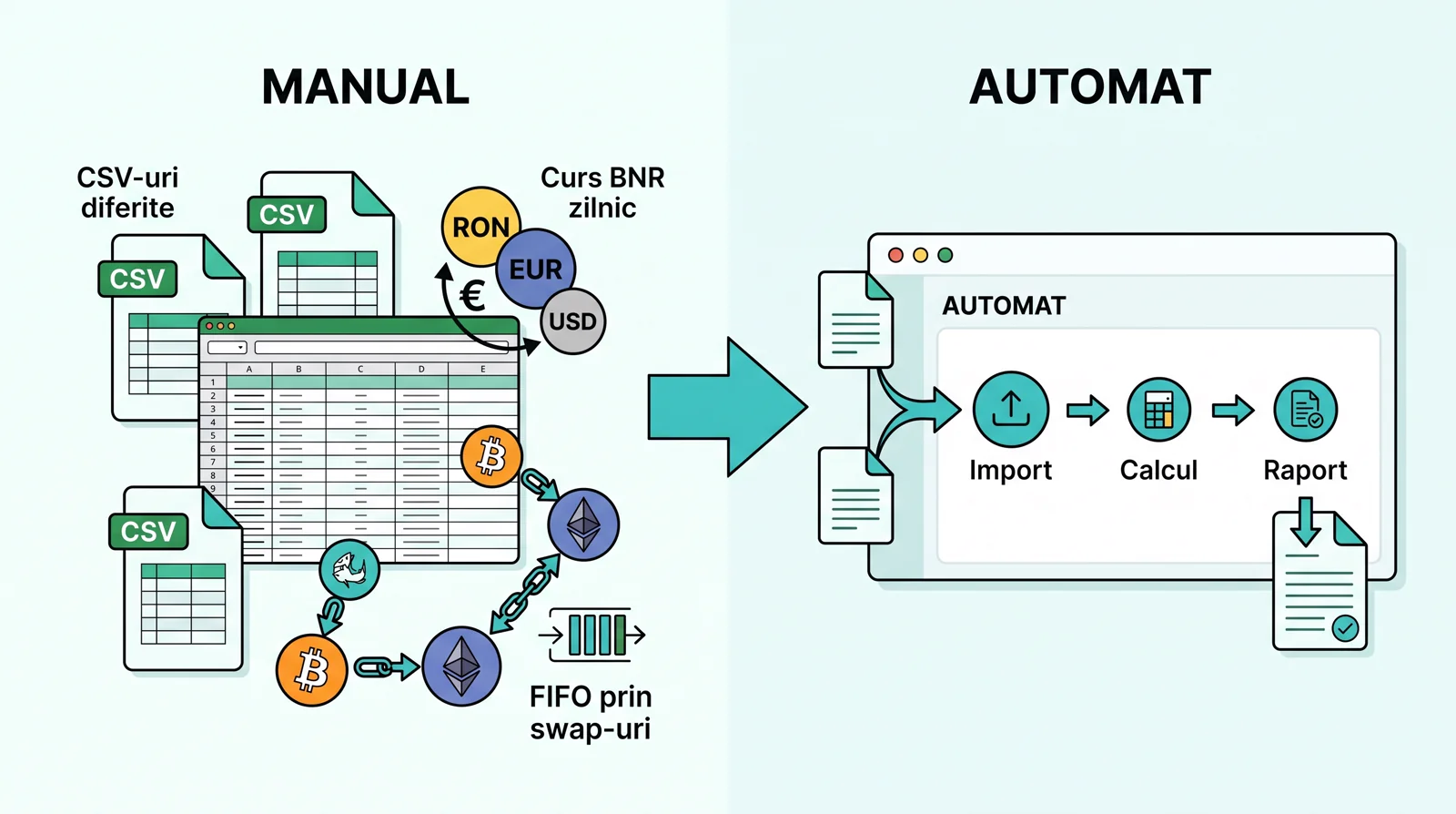
Why you need a crypto tax calculator (and why Excel isn’t enough)
50+ transactions on 3 platforms, daily BNR rates, FIFO, swaps reported under DAC-8. Why working out crypto taxes in Excel fails and what a calculator does.
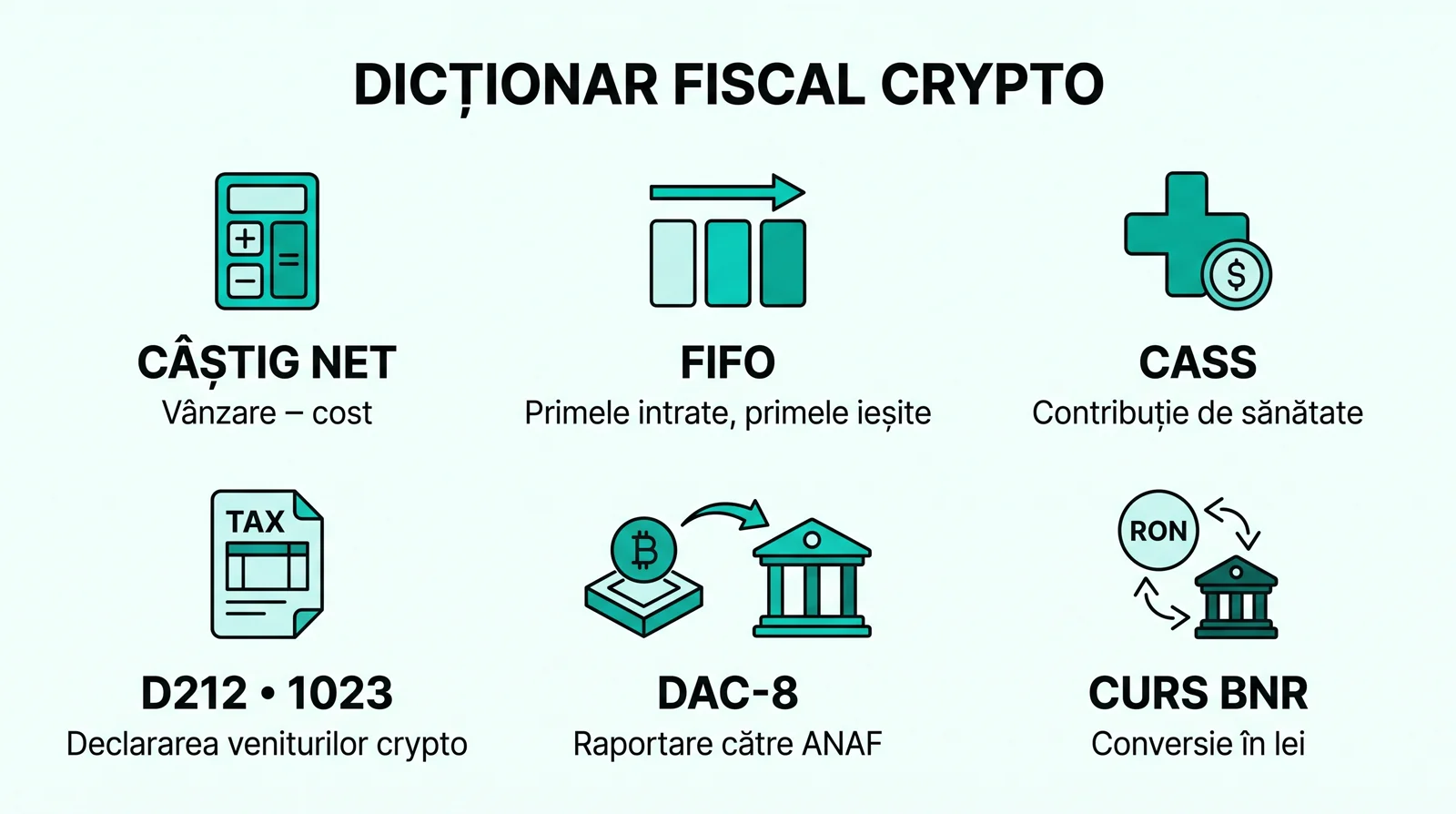
FIFO, CASS, DAC-8: A glossary of crypto tax terms for Romania
What do FIFO, CASS, DAC-8, codes 1023 and 2014 and ‘tax event’ mean? A glossary of crypto tax terms for Romania, explained for investors.
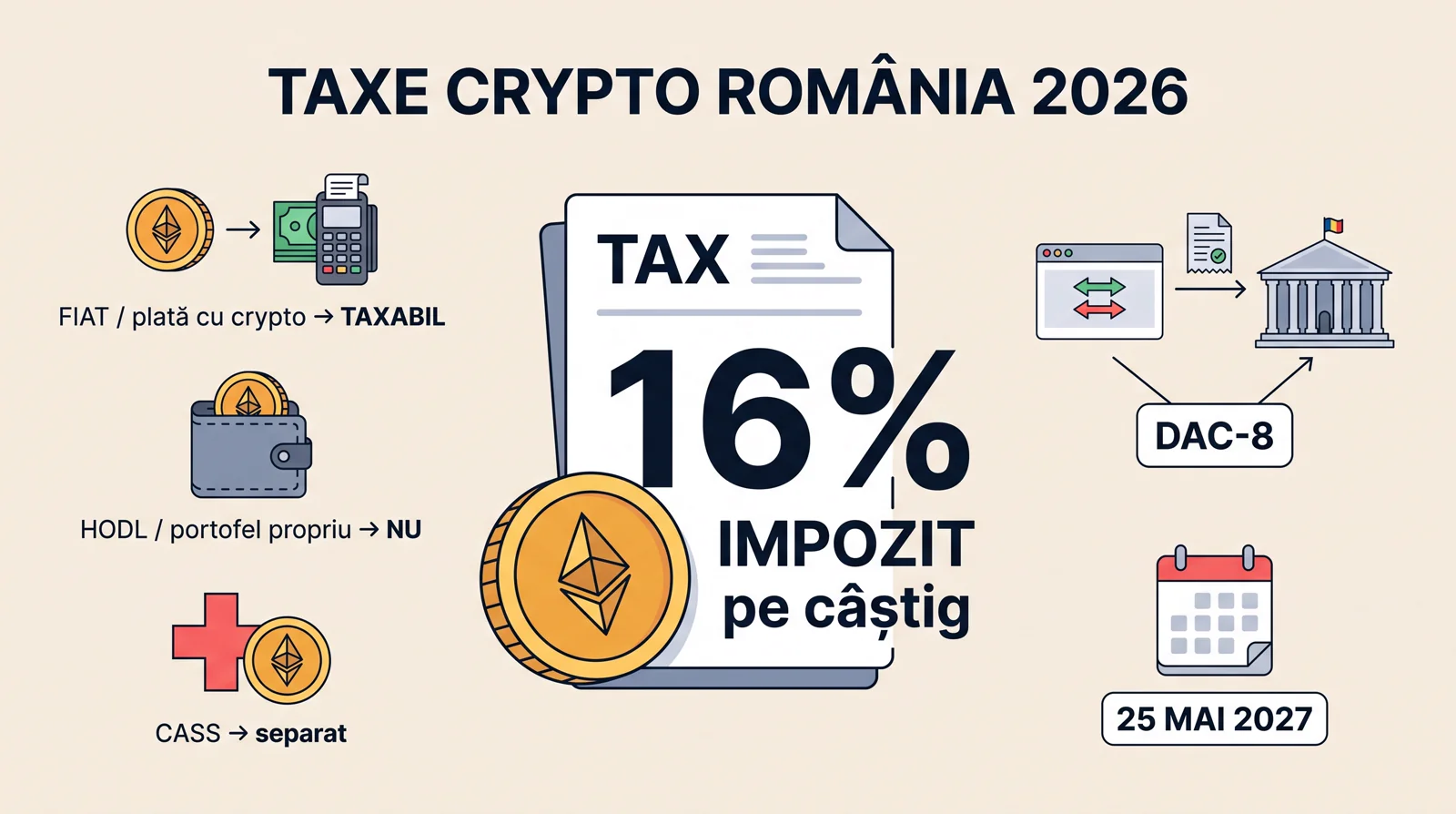
Crypto tax in Romania 2026: the complete guide
How much tax you pay on crypto gains in Romania: 16% from 2026, health contribution (CASS) in brackets, exemption thresholds, the 25 May deadline, DAC-8.