
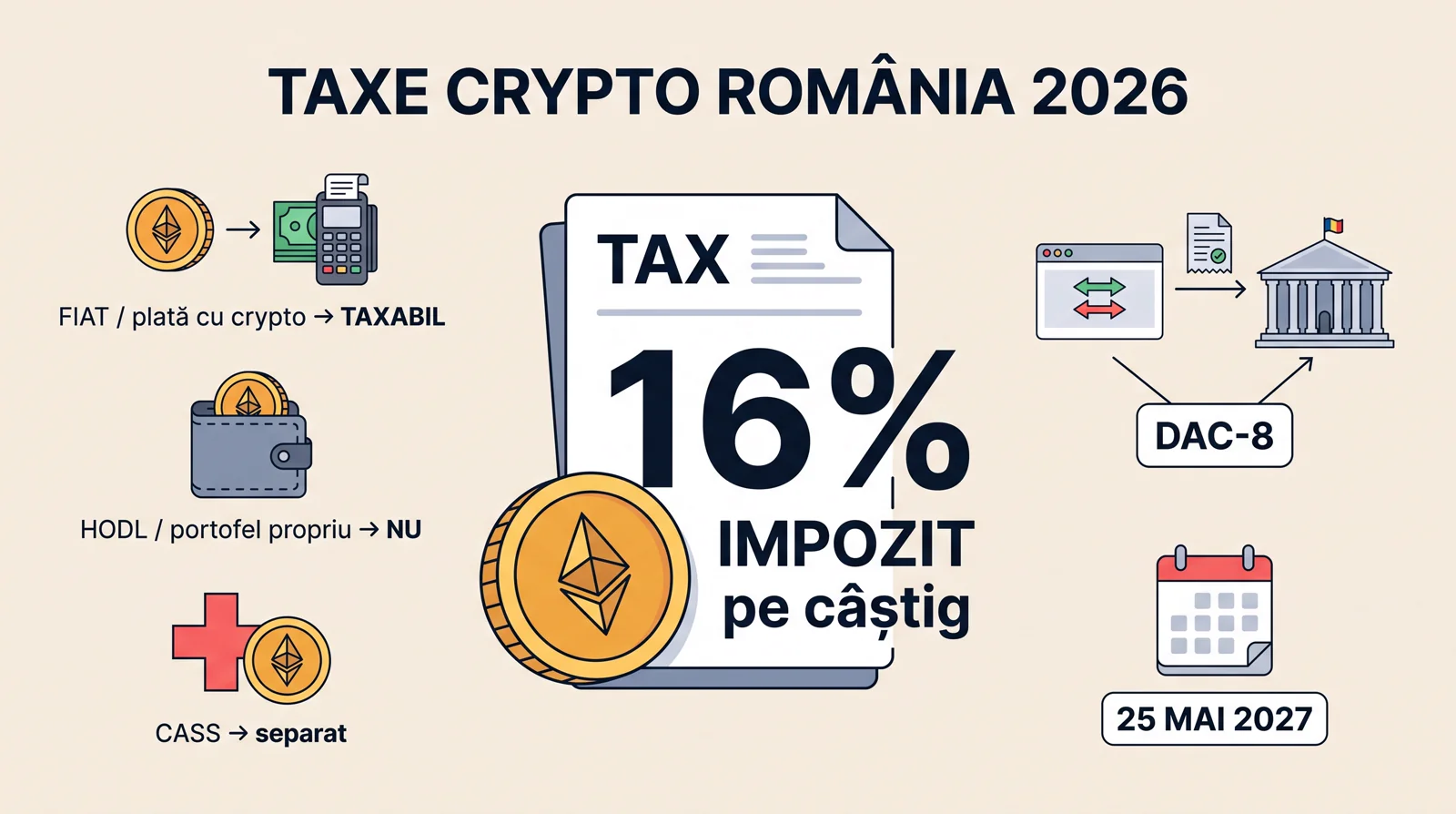
Crypto Taxes in Romania 2026: the complete guide for investors
How much do you pay in tax on crypto gains in Romania: a 16 per cent tax from 2026, a progressive health insurance contribution (CASS), exemption thresholds, a deadline of 25 May and automatic DAC-8 reporting.
The year 2026 fundamentally changed the rules of the game for crypto investors in Romania. The tax rate rose from 10 per cent to 16 per cent, and trading platforms began automatically reporting every transaction to the National Agency for Fiscal Administration (ANAF). Accurate reporting has gone from being ‘recommended’ to ‘mandatory, because the tax authorities know anyway’.
This guide covers the entire framework for cryptocurrency taxation: which law applies, how much you pay (the same rules apply to tax on Bitcoin, Ethereum or any other digital asset), what is taxable and what is not, what exemptions are available, and which deadlines must be met. At the end, you’ll also find answers to the most frequently asked questions.
Legal basis: Article 116 of the Tax Code
Contrary to a persistent myth, crypto taxation in Romania is not a grey area. Gains from the transfer of virtual currency are explicitly regulated by Article 116 of the Tax Code, under the category of income from other sources. The formula is straightforward: you take the net gain - that is, the difference between the sale price and the purchase price - and apply the tax rate.
What is the tax rate: 10% for 2025, 16% from 2026
Under Law 239/2025, the income tax rate has increased:
2025 - Tax rate: 10%; To be declared by: 25 May 2026 (deadline passed; an amended return may be submitted)
2026 - Tax rate: 16%; To be declared by: 25 May 2027
The jump from 10 per cent to 16 per cent means a 60 per cent increase in tax. If you had income in 2025 and did not declare it by 25 May 2026, the legal solution is to submit an amended tax return: you pay the tax and interest, but avoid the penalty for non-declaration, which is the most costly element.
Contributions: zero pension, healthcare on a sliding scale
First, the good news: for income from crypto, the pension contribution (CAS) is zero. These earnings are not considered income from employment, so they do not give rise to any pension obligations or entitlements.
The health contribution (CASS) is payable, but bear in mind how it works: it is not a percentage of earnings, but a fixed amount based on income brackets.
under 24,300 lei - 0 lei if you have other taxable income (e.g. salary); 2,430 lei if crypto is your only source of income
24,300 - 48,600 lei - 2,430 lei
48,601 - 97,200 lei - 4,860 lei
over 97,200 lei - 9,720 lei (maximum limit)
The ceiling of 9,720 lei is the absolute maximum: whether your income is 100,000 lei or one million, the contribution remains the same. This gives rise to an interesting paradox: the more your income exceeds the ceiling, the lower the total effective tax rate becomes.
A comprehensive calculation, based on figures
Let’s say you bought Bitcoin for 200,000 lei and sold it for 300,000 lei in 2026.
Net earnings: 100,000 lei
Income tax: 16% × 100,000 = 16,000 lei
CASS: earnings exceed 97,200 lei, so the maximum contribution is 9,720 lei
Total tax due: 25,720 lei
What is taxable and what is not
Article 116 covers traditional cryptocurrencies (Bitcoin, Ethereum), stablecoins (USDT, USDC), NFTs and tokens from play-to-earn games. Fiat currencies, loyalty points or in-game currencies that can only be converted within the game are not covered.
Equally important is the point at which the tax liability arises:
Taxable - Selling cryptocurrency for lei, euros or dollars; Paying for goods or services with crypto
Grey area - Crypto-to-crypto swaps (see note below)
Not taxable - Buying cryptocurrency with lei; Long-term holding (HODL); Transferring between your own wallets
The golden rule: it is the date of the transaction that counts, not the date the money is withdrawn into your account. A sale in euros that remains on the platform is just as taxable as one that is withdrawn into your bank account.
When it comes to swaps, there are two key points to note. Firstly, the general understanding in Romania is that the swap itself is not taxable; however, ANAF has not published any specific official guidance on this, so it remains a grey area, and some taxpayers opt for the prudent approach and treat each swap as a sale for tax purposes. Secondly: regardless of the approach taken, the initial acquisition cost is transferred to the currency received; it is not reset. In a chain of swaps, it is precisely this transfer of cost that makes the difference between a correct calculation and one that falls apart during an audit; we go through the figures, step by step, in the chapter on tax events and swaps in the course.
And when it comes to losses, here’s the rule that takes everyone by surprise: losses are not deducted from gains. The Declarația Unică form does not have a section for them. The total amount of gains is taxed, regardless of any loss-making transactions.
The 200 / 600 lei exemption
The exemption of 200 RON per transaction and 600 RON per year is the only one provided for by law and is subject to two cumulative conditions: each gain per transaction must be less than 200 lei AND the total annual gains must be less than 600 lei. Both must be met simultaneously. Five winnings of 150 lei each satisfy the first condition, but the total of 750 lei exceeds the annual threshold; therefore, the entire sum of 750 lei is taxed, not just the difference.
Passive income: staking, airdrops, mining
Rewards from staking, airdrops and hobby mining are treated in the same way: they are not taxed upon receipt, but have a zero acquisition cost. When you sell them for lei, the entire amount received is taxable income, at 16 per cent. You’ll find details on which date to record for each type of passive income, how to deal with a hard fork or a gift in crypto, and the full calculations for each scenario in the chapter on passive income in the course.
Constant mining, generating recurring income of tens of thousands of lei per year, can be classified as an economic activity, requiring registration as a sole trader (PFA) or a limited liability company (SRL), each with completely different tax regimes. In such cases, consulting a specialist is essential.
DAC-8: the tax authorities will have full visibility from 2026
The biggest change of the year is not the tax rate, but transparency. The European DAC-8 Directive, transposed into Romanian law, requires all crypto platforms - from international giants to local ones - to automatically report transactions by Romanian customers to ANAF.
The timeline is already in motion: the platforms will start collecting data from 1 January 2026, and on 15 March 2027 they will submit their first full report, covering all activity in 2026. The tax authorities will have two documents on the table: the platform’s report and your tax return. And they will compare them, figure by figure.
Swaps (as sales plus purchases, valued in lei) and withdrawals to private wallets are also reported, with the exact value at the time of the transfer. The idea that moving funds to a cold wallet hides something is a myth: the platform reports the outflow and to whom it belongs.
Deadlines and reporting
Income must be declared via the Declarația Unică (formularul 212), directly on the ANAF website via the Spațiul Privat Virtual, under codul de venit 1023. The filing period is 1-25 May, and 25 May is the absolute deadline for both filing and payment. Supporting documents must be retained for at least five years.
In 2026, for the first time, there was also a 3 per cent income tax rebate (OUG 8/2026) for those who filed their tax return and paid in full by 15 April 2026. This scheme may be repeated for the 2027 tax return, so it is worth keeping an eye on the tax calendar this spring.
Where do you actually start?
The first step is simple, but fundamental: a list of all the platforms and wallets where you carried out any activity in 2026, followed by the export of your full transaction history. This is where any accurate calculation begins, and the entire process - from CSV files to the final figure on your tax return - is exactly what we’re going through in this course.
Frequently Asked Questions
What will the tax on cryptocurrency be in Romania in 2026?
16 per cent of net earnings, for income earned from 1 January 2026. In addition to tax, there is the CASS, a fixed amount ranging from 2,430 to 9,720 lei, depending on annual earnings.
Does the 16 per cent tax on crypto from 2026 also apply to gains made in 2025?
No. The old rate of 10 per cent applies to gains realised in 2025; the new rate of 16 per cent applies only to transactions from 1 January 2026 onwards.
Do I have to pay tax if I just hold crypto and don’t sell it?
No. Purchasing and holding are not taxable events. The tax liability arises when the assets are sold for fiat currency or when crypto is used to pay for goods and services.
Is the Bitcoin-Ethereum swap subject to tax?
The general view is that it is not, but in the absence of official guidance from ANAF, the matter remains a grey area; some prefer to take a conservative approach and tax it. In both cases, the acquisition cost is allocated to the currency received, and the platforms report each swap to ANAF.
What happens if I don’t declare it?
Through DAC-8, ANAF receives the full report from the platforms. Upon detection, the tax authorities may recalculate the tax based on a zero acquisition cost and add interest, late payment penalties and the penalty for failure to declare. A profit of 80,000 lei, which if voluntarily declared would cost around 18,300 lei, can end up costing over 50,000 lei.
By when do I need to declare my 2026 earnings?
By 25 May 2027, via Declarația Unică, under codul de venit 1023.
This is the general framework. We go through its application to real-life scenarios - including chain swaps, staking, NFTs, card payments and the actual completion of the tax return - step by step in the video course From Crypto to ANAF, 2026 edition, verified by CECCAR accountants. The automatic calculation of earnings, involving data imports from hundreds of exchanges and conversion at the BNR exchange rate, is handled by The Crypto Support app.
Content verified by CECCAR-certified accountants. This information is provided for educational purposes only and is not a substitute for personalised tax advice.
Need your own tax report?
Import your transactions and get the figures for the Unique Declaration, calculated by ANAF rules.
Read next
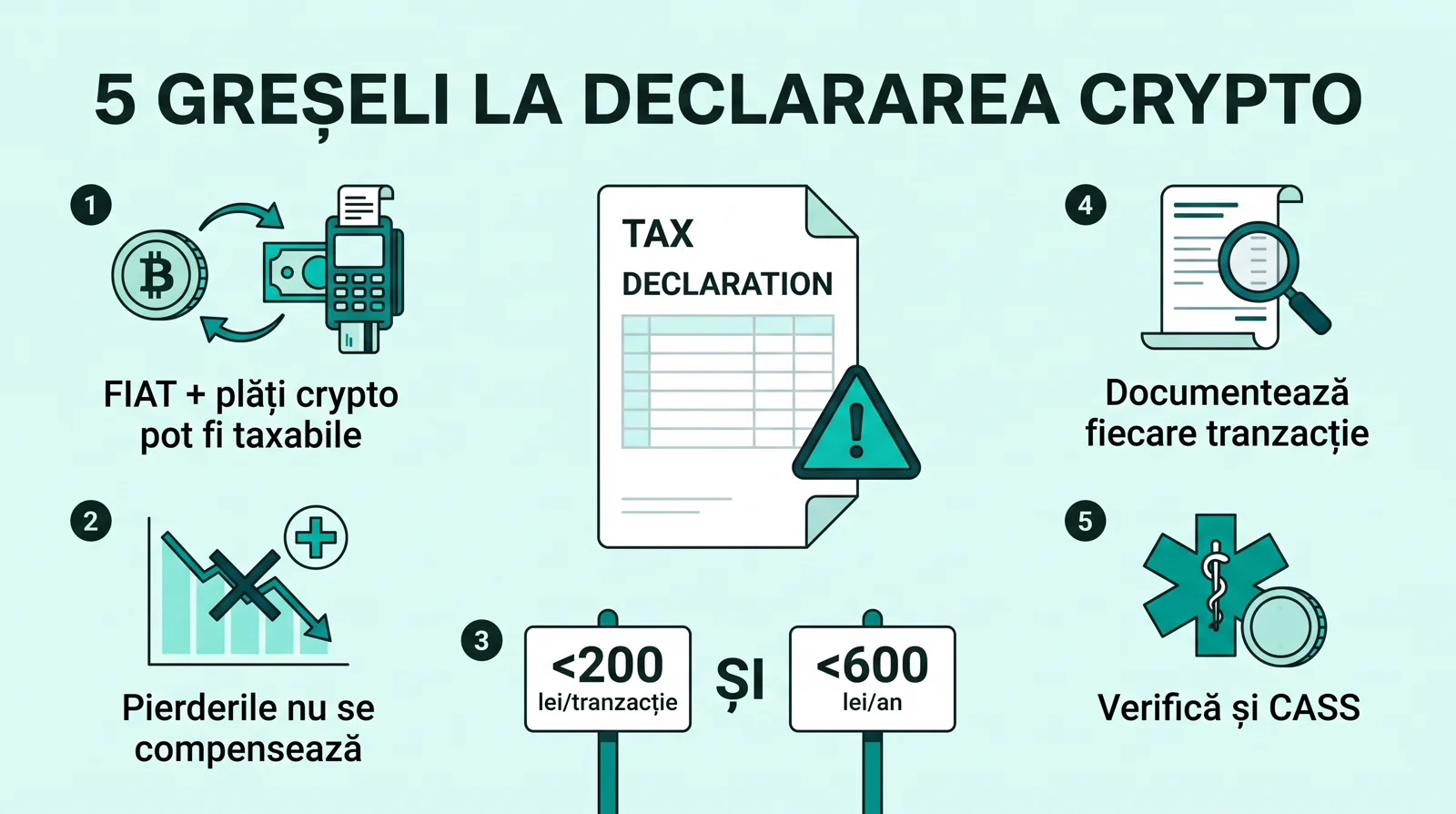
5 common mistakes when declaring crypto (and why they can cost you three times as much)
Didn’t you sell in lei? Are you making a loss? Are you below 600 RON? The 5 mistakes that lead to fines and penalties from ANAF when declaring crypto, explained with real-life examples.
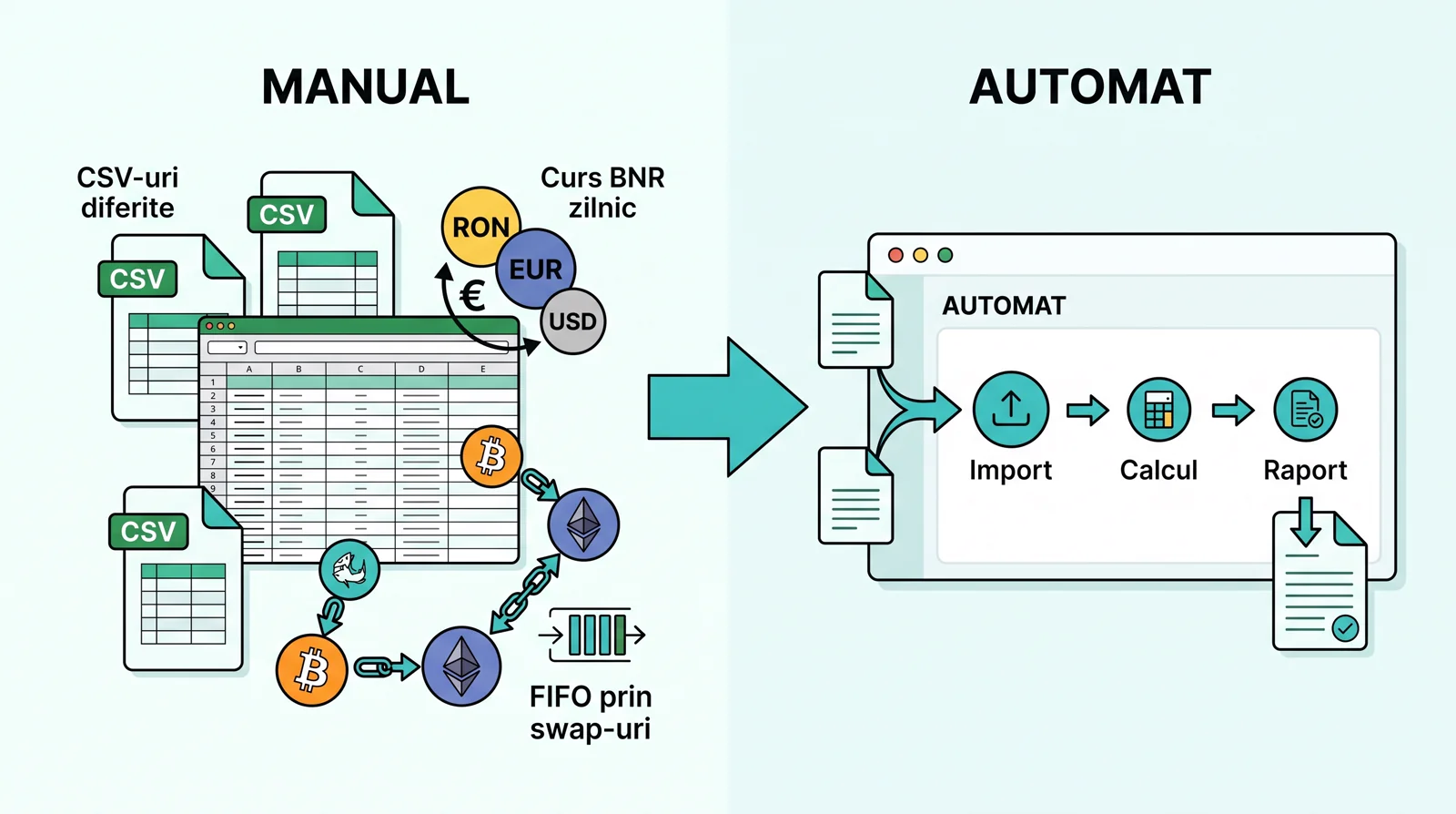
Why you need a crypto tax calculator (and why Excel isn’t enough)
50+ transactions across 3 platforms, daily BNR exchange rates, FIFO, swaps reported via DAC-8. Why manually calculating crypto taxes in Excel fails, and what an automated calculator does.
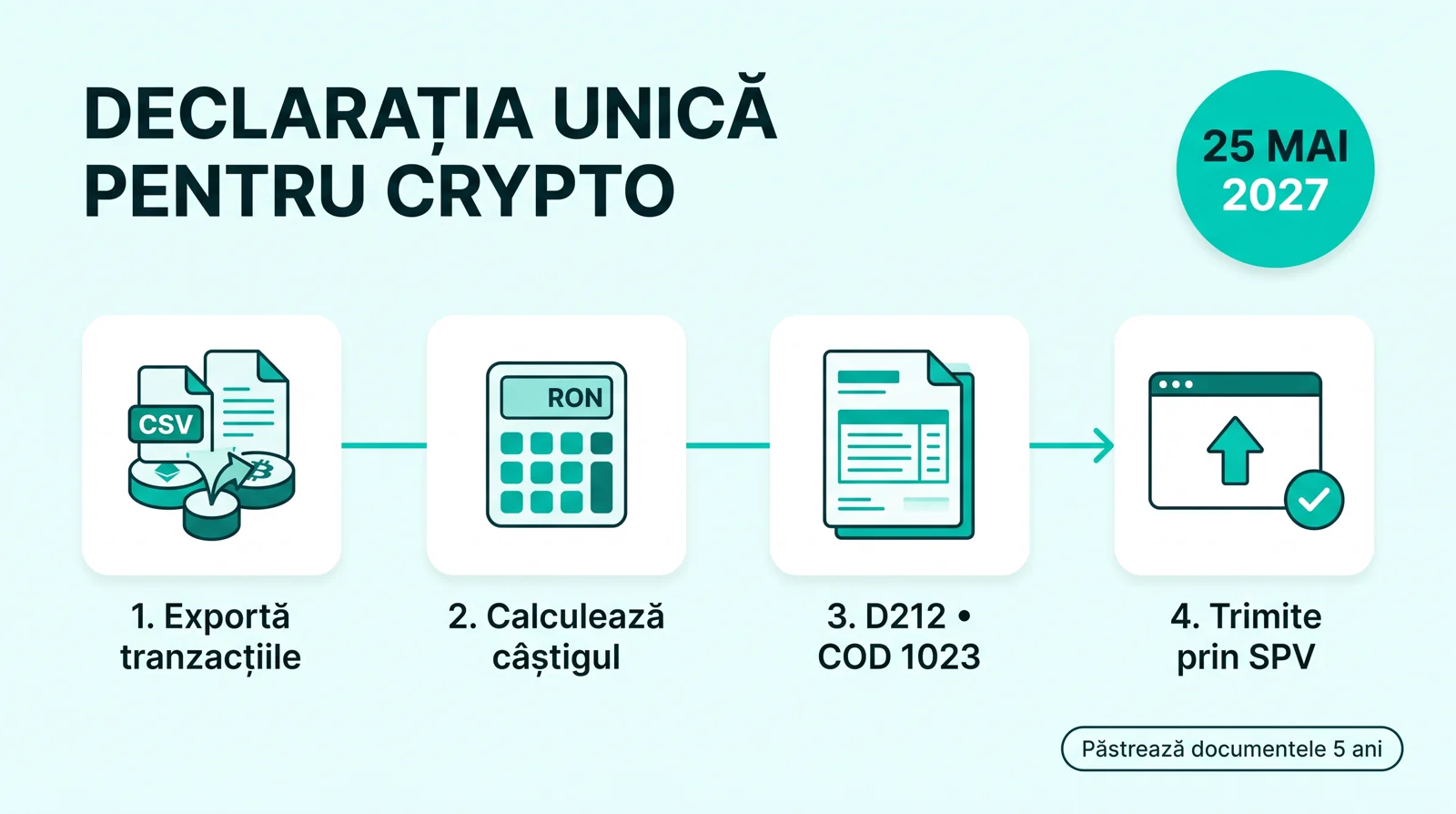
Declarația Unică pentru crypto: what you need to know before completing formularul 212
How to declare cryptocurrency to ANAF via the Declarația Unică: what documents to prepare, codul de venit 1023, the 25 May deadline, the 3 per cent discount, and what you risk if you fail to declare it.