
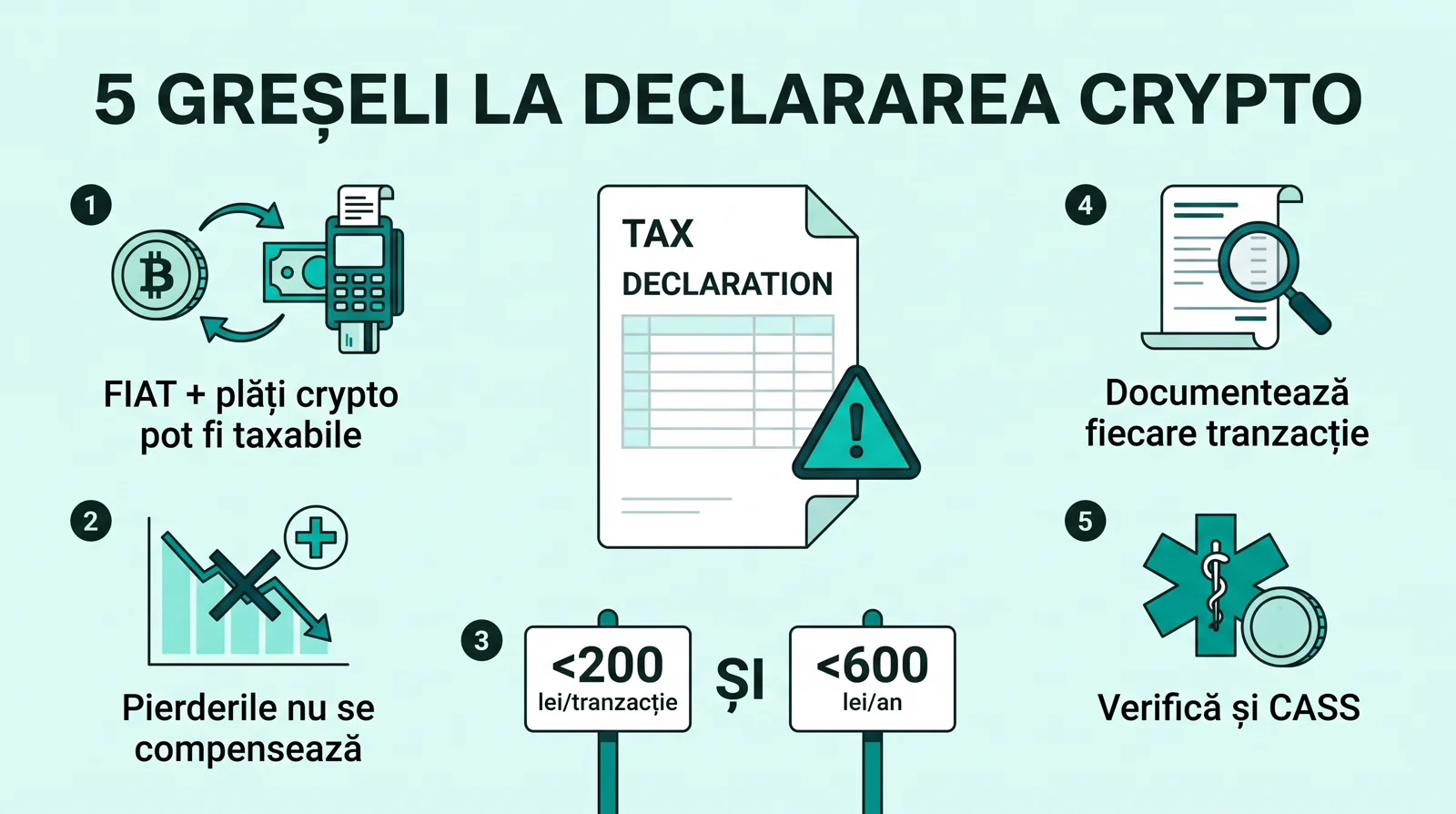
5 common mistakes when declaring crypto (and why they can cost you three times as much)
Didn’t you sell in lei? Are you making a loss? Are you below 600 RON? The 5 mistakes that lead to fines and penalties from ANAF when declaring crypto, explained with real-life examples.
There is a scenario that repeats itself every year. An investor does their own calculations, is convinced they have understood the rules, submits their tax return or decides they have nothing to declare. Then, following an audit or a simple notification from ANAF, they discover that they started from a false premise. And the difference between a false premise and a correct one runs into thousands of lei.
The figure that puts everything into perspective: on a real income of 80,000 lei, voluntary declaration means tax of around 18,300 lei. Failure to declare, followed by an audit, can push the bill to over 50,000 lei, because the tax authorities apply the ‘zero acquisition cost’ rule, to which interest, late payment penalties and the penalty for non-declaration are added. That is nearly three times as much.
And from 2026, with automatic DAC-8 reporting, the question is no longer whether the tax authorities will find out, but when. The rules below apply equally whether we are talking about tax on Bitcoin, Ethereum or any other cryptocurrency. These are the five mistakes we see most often.
Mistake 1: “I didn’t sell in lei, so I’ve got nothing to declare”
The most common misconception. Many people believe that tax liability only arises when the money is credited to their bank account, in lei.
The reality is that the tax event occurs on the date of the transaction, not on the date of withdrawal. Have you sold crypto for euros or dollars on a platform? It counts as a sale, even if the money remained on the platform. Did you pay for a laptop or a coffee with your crypto card? That’s still a sale, because you’ve converted a digital asset into goods. Payments made with a crypto card are among the transactions most frequently omitted from tax returns, and the platforms report them all.
What matters is the date on which the transaction took place, valued in lei at that time. Any subsequent withdrawal into the account is irrelevant for tax purposes.
Mistake 2: “I’m making a loss, so I don’t have to pay anything”
It seems logical: if you’ve made a profit of 10,000 lei on some transactions and lost 12,000 on others, you’re in the red, so there’s nothing to tax. Except that the Romanian tax system doesn’t work like that.
Declarația Unică simply does not have a section for crypto losses. The law only takes into account positive gains, on a per-transaction basis. Offsetting crypto losses against gains is simply not provided for in current legislation, and losses cannot be carried forward to subsequent years. In the example above, tax is due on all 10,000 lei earned, regardless of the 12,000 lei lost.
It is one of the most frustrating rules in the entire system, and that is precisely why it is important to be aware of it before you plan your transactions, not afterwards. It is worth noting here that some international sources, including English-language guides on taxation in Romania, incorrectly state that losses are offset. In Romania, they are not.
Mistake 3: “I’ve got less than 600 lei, so I’m exempt”
The exemption does exist, but there are two conditions that must be met simultaneously, and this is where most people fall short:
Profit per transaction - under 200 lei
Total earnings for the entire tax year - under 600 lei
Not one or the other. Both.
And the catch is more subtle than it seems: the threshold does not function as a deduction, but as a switch. Either you are fully exempt, or everything is taxed, from the very first lei, not just the amount exceeding the threshold. We go through the exact scenarios in which the exemption is lost, with examples using figures that take everyone by surprise, in the chapter on thresholds and exemptions in the ‘From Crypto to ANAF’ course.
Mistake 4: “I declared everything as a single amount, without a detailed calculation”
The form does indeed ask you for just one final figure: your annual net income, under cod 1023. However, that figure must be the result of a correct calculation, on a transaction-by-transaction basis, with valuation in lei on the date of each transaction and with the acquisition cost tracked through all swaps.
A figure estimated ‘by eye’ won’t stand up to scrutiny. The tax authorities receive, via DAC-8, the platforms’ full report and compare it with your tax return, figure by figure. And if you cannot provide evidence of how you arrived at the declared amount, your calculation becomes merely an opinion, and the tax authorities may recalculate it to your disadvantage, including by assigning a zero purchase cost where you have no proof of purchase.
Supporting documents must be kept for at least 5 years. The transaction history exported from the platforms, the record of swaps, and the exchange rate used: all form part of your insurance policy.
Mistake 5: "I didn’t know about CASS"
Many people calculate their income tax correctly and leave it at that. Then, when they complete their tax return, the system displays a higher figure than they expected, and panic sets in.
The difference lies in the health insurance contribution, known as CASS. When calculating CASS for crypto earnings, the rule is surprising: it is not a percentage of earnings, but a fixed amount based on three income brackets, which can reach up to 9,720 lei. And being placed in the correct bracket depends on details that few people are aware of: whether or not you receive a salary, whether crypto is your sole source of income, and the exact range within which your net earnings fall. Two people with seemingly similar earnings may owe completely different amounts.
You can find the complete table of tax brackets, the exceptions and a step-by-step calculation for each scenario in the chapter of the course dedicated to contributions.
What should you do if you’ve already made one of these mistakes?
The good news is that there is a legal way out: the amended tax return, which allows you to voluntarily correct previous years’ returns and avoid the penalty for non-filing - the component that drives up the bill the most. When and how to submit it correctly, what you’ll pay and exactly what you’ll avoid is covered in the chapter on risks and compliance in the course.
Frequently Asked Questions
What fines does ANAF impose for undeclared cryptocurrency?
The fine for failing to file a return ranges from 50 to 500 lei, but that is the least of it. The real cost comes from the tax recalculated by the tax authorities, late payment interest, late payment penalties and the penalty for failure to file, which accrue day by day.
Does ANAF actually find out about my transactions on foreign platforms?
Yes. Under DAC-8, all platforms serving customers in Romania will collect data from 1 January 2026 and submit their first full report to ANAF on 15 March 2027. This includes reporting on swaps and withdrawals to private wallets.
If I move my cryptocurrency to a hardware wallet, will it still appear in the reports?
The platform reports the outflow and its value in lei at the time of the transfer. The tax authorities may not know the wallet address, but they know exactly what amount left the platform and to whom it belonged.
Can I correct a declaration that has been submitted incorrectly?
Yes, by submitting a corrective return, at any time before the tax authorities initiate an audit. It’s the smartest way to wrap up a problematic financial year.
These are the mistakes. We go through the correct, step-by-step calculation, covering all scenarios - from chain swaps to staking and NFTs - in full in the video course From Crypto to ANAF, 2026 edition, verified by CECCAR accountants. And for situations that are already complicated, we offer one-to-one tax assistance with a chartered accountant, just a click away.
Content verified by CECCAR-certified accountants. This information is for educational purposes only and is not a substitute for personalised tax advice.
Need your own tax report?
Import your transactions and get the figures for the Unique Declaration, calculated by ANAF rules.
Read next
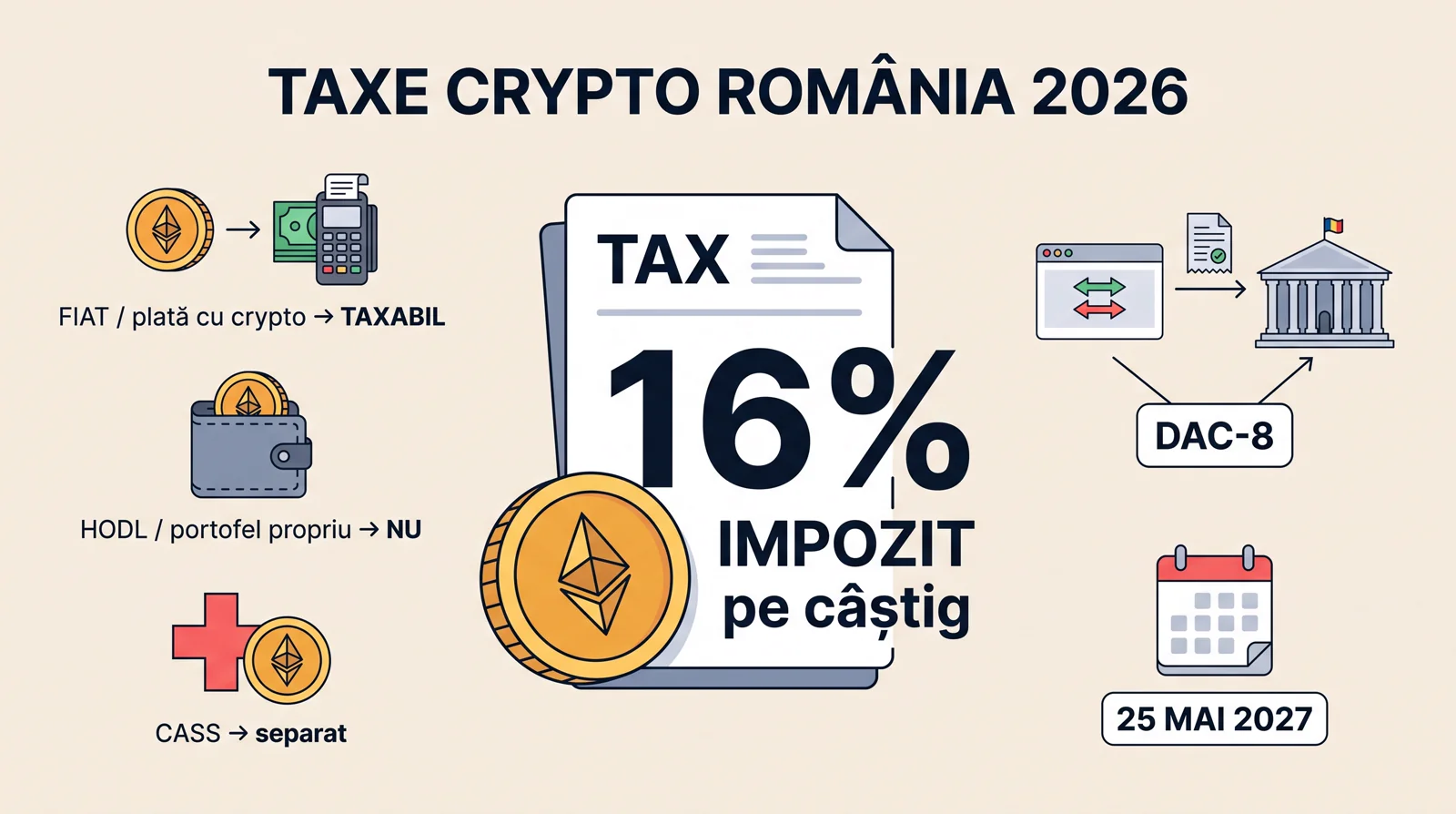
Crypto Taxes in Romania 2026: the complete guide for investors
How much do you pay in tax on crypto gains in Romania: a 16 per cent tax from 2026, a progressive health insurance contribution (CASS), exemption thresholds, a deadline of 25 May and automatic DAC-8 reporting.
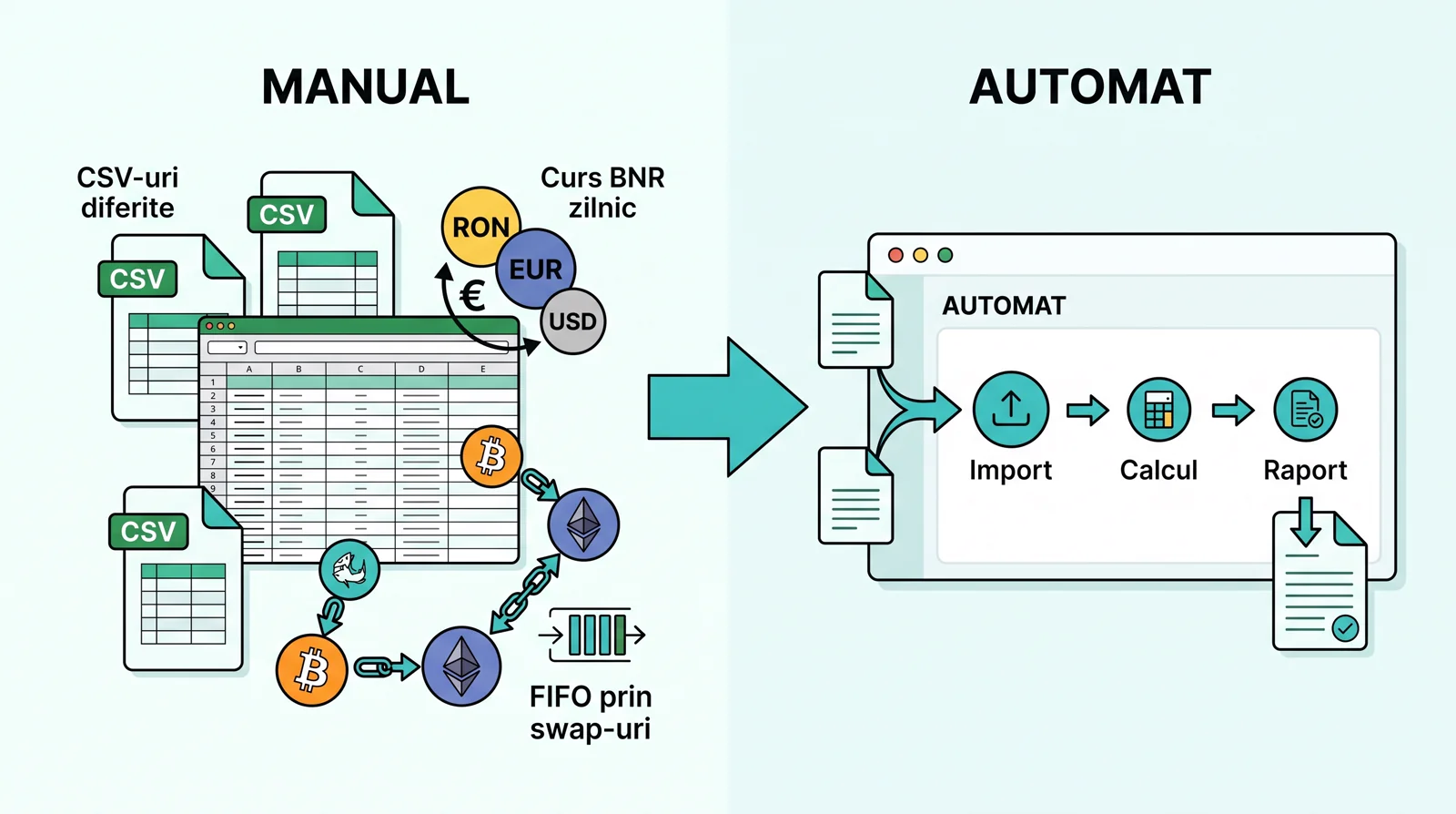
Why you need a crypto tax calculator (and why Excel isn’t enough)
50+ transactions across 3 platforms, daily BNR exchange rates, FIFO, swaps reported via DAC-8. Why manually calculating crypto taxes in Excel fails, and what an automated calculator does.
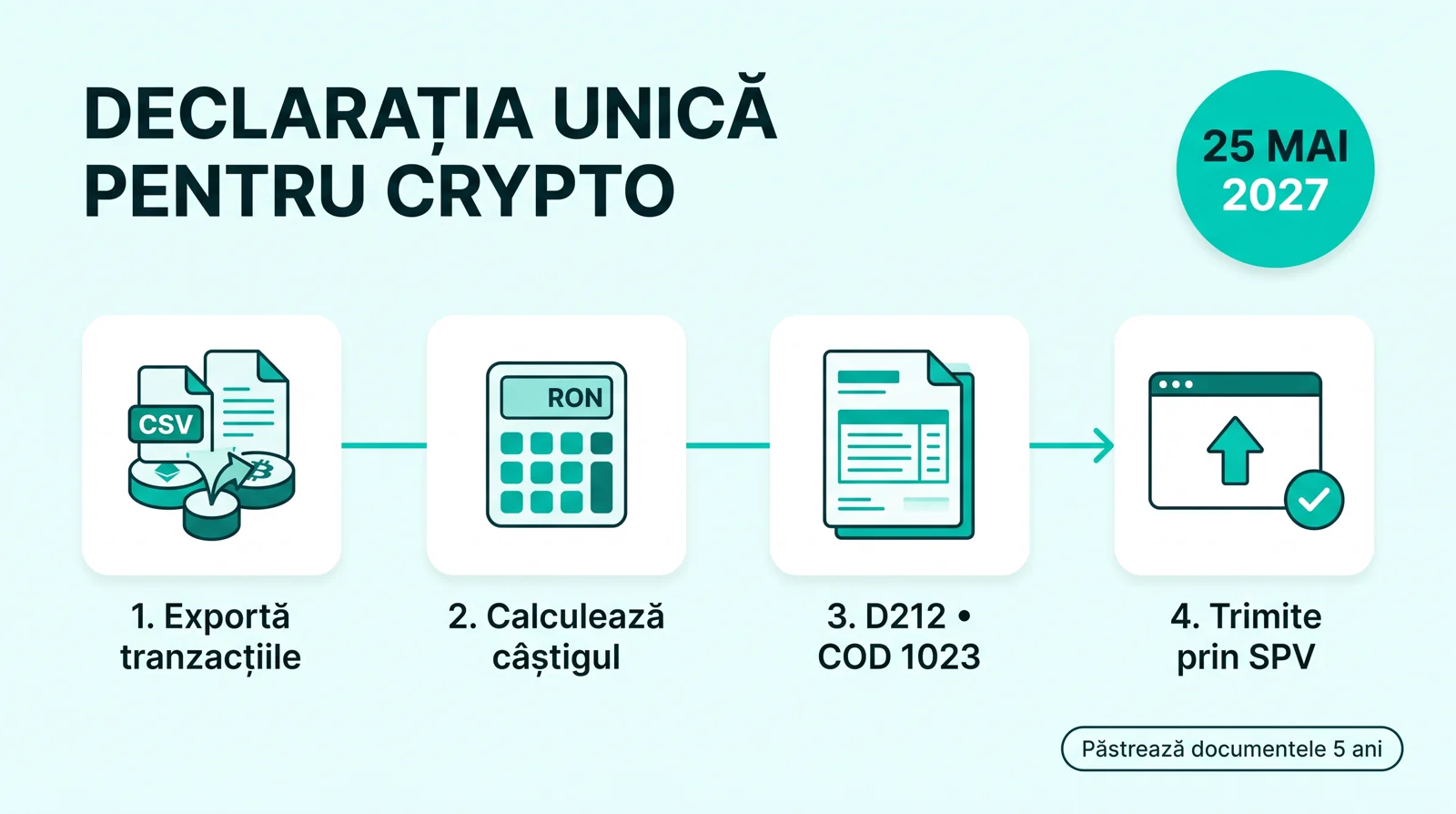
Declarația Unică pentru crypto: what you need to know before completing formularul 212
How to declare cryptocurrency to ANAF via the Declarația Unică: what documents to prepare, codul de venit 1023, the 25 May deadline, the 3 per cent discount, and what you risk if you fail to declare it.