
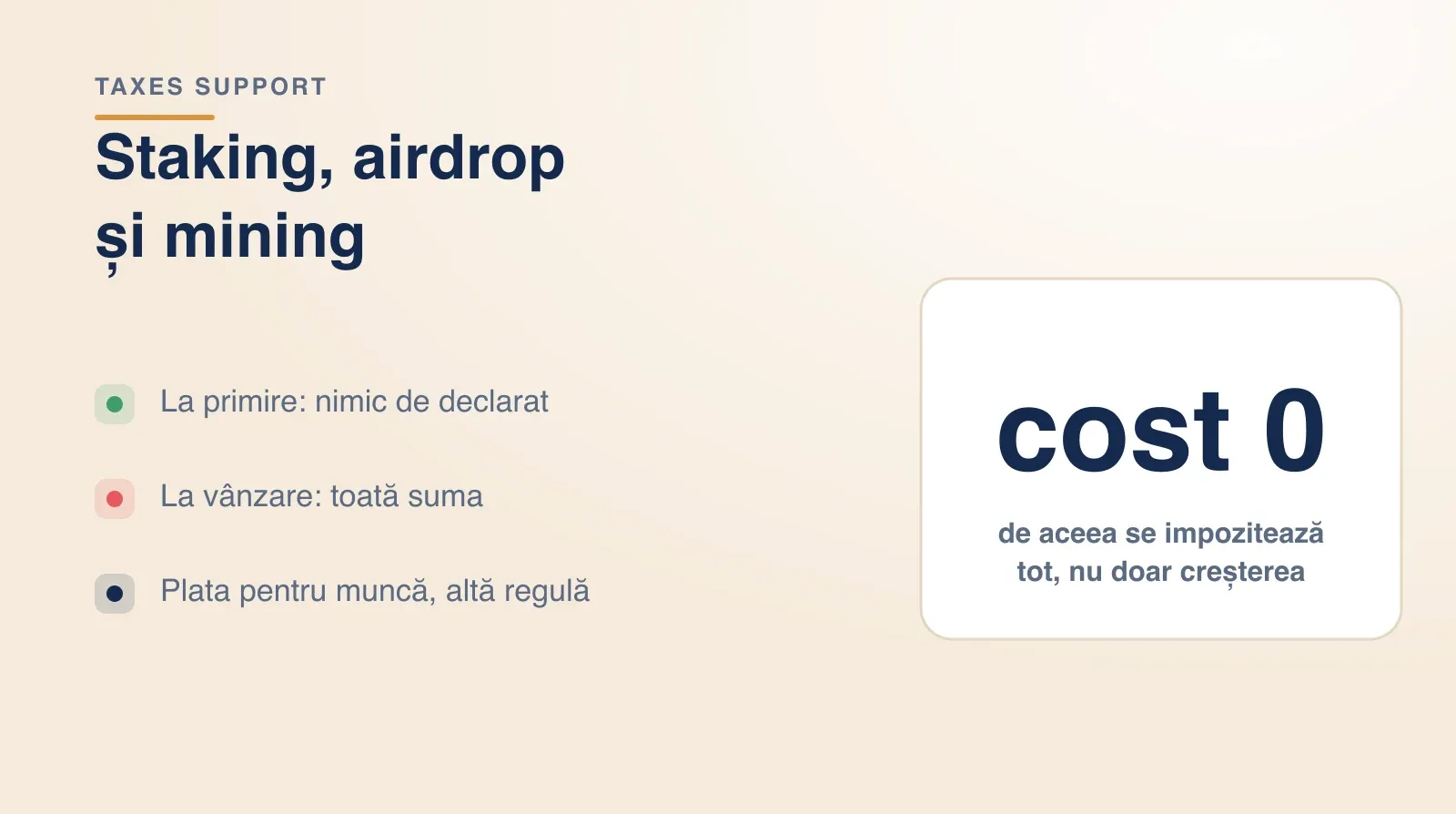
Staking, airdrops and mining: nothing to declare on receipt, everything on sale
Rewards are not taxed in the year they reach your wallet. Their cost stays at zero, so when you sell, the whole amount is taxed.
Methodology reviewed with CECCAR chartered accountants.
Rewards from staking, airdrops and mining are not taxed when you receive them. Their acquisition cost is zero, so when you sell them for money the whole amount received is taxed, at 16% for 2026 gains (Article 116 of the Tax Code), declared in the Declarația Unică by 25 May 2027. The exception is crypto received as payment for work.
You get staking rewards every week. An airdrop landed in your wallet. You have been mining for two years. The question is always the same: do you declare them when they arrive?
The short answer: no. The long answer is why many people end up paying more than they expected.
Nothing happens for tax when you receive them
A staking reward, an airdrop or a mined coin is not taxed when it reaches you. Because of it, the year you received it has nothing to declare.
That is the good news, and it is the part everyone remembers.
The cost stays at zero. That is the part that costs
Since you paid nothing for those coins, their acquisition cost is zero.
And when you sell, the taxable gain is the difference between what you received and what the coins cost you. If they cost zero, the gain is the whole amount.
Not just the increase in value since you received them. All of it.
The logic is consistent: the value was not taxed on the way in, so it is taxed on the way out. You pay once, but you pay on everything.
Why "I paid nothing for them" does not help
It is the reasoning that most often leads to a wrong return: I did not buy them, so I have nothing to declare.
It is the other way round. Precisely because you did not buy them, you have nothing to deduct. On a coin you bought, only the increase is taxed; the same coin received for free is taxed on the whole sale amount.
Free on the way in becomes zero cost on the way out.
The exception: crypto received as payment for work
If you were paid in cryptocurrency for work, a salary, a collaboration or a contract, the rule is different.
That payment is taxable income when you receive it, like any pay, and it is declared at that point, outside the crypto calculation. That is exactly why the cost of those coins is no longer zero: it is their market value on the day you received them.
The consequence works in your favour: when you sell, only the later increase is taxed, not the whole amount. The initial value has already been taxed once, as income.
The distinction matters, and it is easy to miss in a raw history: a transfer received from a company looks, in an export, exactly like any other incoming transaction. If it was payment for work, mark it as such, otherwise the calculation treats it as a reward and gives it a zero cost.
What to do in practice
1. Do not ignore the years "without sales". Rewards create no tax when you receive them, but they have to be on record, otherwise at the sale it is not clear what was sold.
2. Import your whole reward history. Staking produces hundreds of small entries; they determine how much you hold, and the quantity matters at every sale.
3. Mark payments for work. It is the only category that changes the cost from zero to market value.
4. Do not apply the 200 lei threshold on receipt. The threshold concerns the gain from a transaction, and there is no gain on receipt. It matters at the sale.
The final figures go into the Declarația Unică, together with the rest of your income from virtual currency. The same thresholds and rates apply.
The uncertain area, said plainly
The treatment of rewards has no dedicated official clarification from ANAF. For mining in particular, there is also a reading in which an activity carried out systematically would be income from independent activities, under a different regime, a question that depends on the scale and organisation of your activity.
We apply the treatment above consistently, for the ordinary case of an individual. If you mine at scale or your set-up looks like a business, it deserves a separate discussion: the answer there may be different, and it comes from an authorised tax consultant, a member of the Romanian Chamber of Tax Consultants.
Legal basis: Article 116 of the Tax Code, income from the transfer of virtual currency, and Law 239/2025, for the 16% rate from 2026.
Frequently asked questions
Do I declare staking rewards in the year I receive them?
No. Nothing happens for tax on receipt; tax arises when you sell them for money or pay with them.
Why is the whole amount taxed when I sell?
Because rewards have a zero acquisition cost: there is nothing to deduct from the amount received, so the gain is the whole amount, not just the increase in value.
Is crypto received as payment for work treated the same way?
No. It is taxable income on receipt, declared separately, and the cost of the coins becomes their market value on the day you received them.
Is large-scale mining taxed the same way?
Not necessarily. An activity carried out systematically can be classed as an independent activity, under a different regime; there, the answer comes from an authorised tax consultant.
Taxes Support imports the hundreds of small staking rewards at zero cost, so that selling them is calculated correctly.
Busola Fiscala
Tax news for investors and accountants. The essentials of crypto and capital markets taxation, sent every two weeks.
Read past articlesNeed your own tax report?
Import your transactions and get the figures for the Unique Declaration, calculated by ANAF rules.
Want the full method, with real examples and calculations? See the Comets of Web3 courses (in Romanian)
Read next
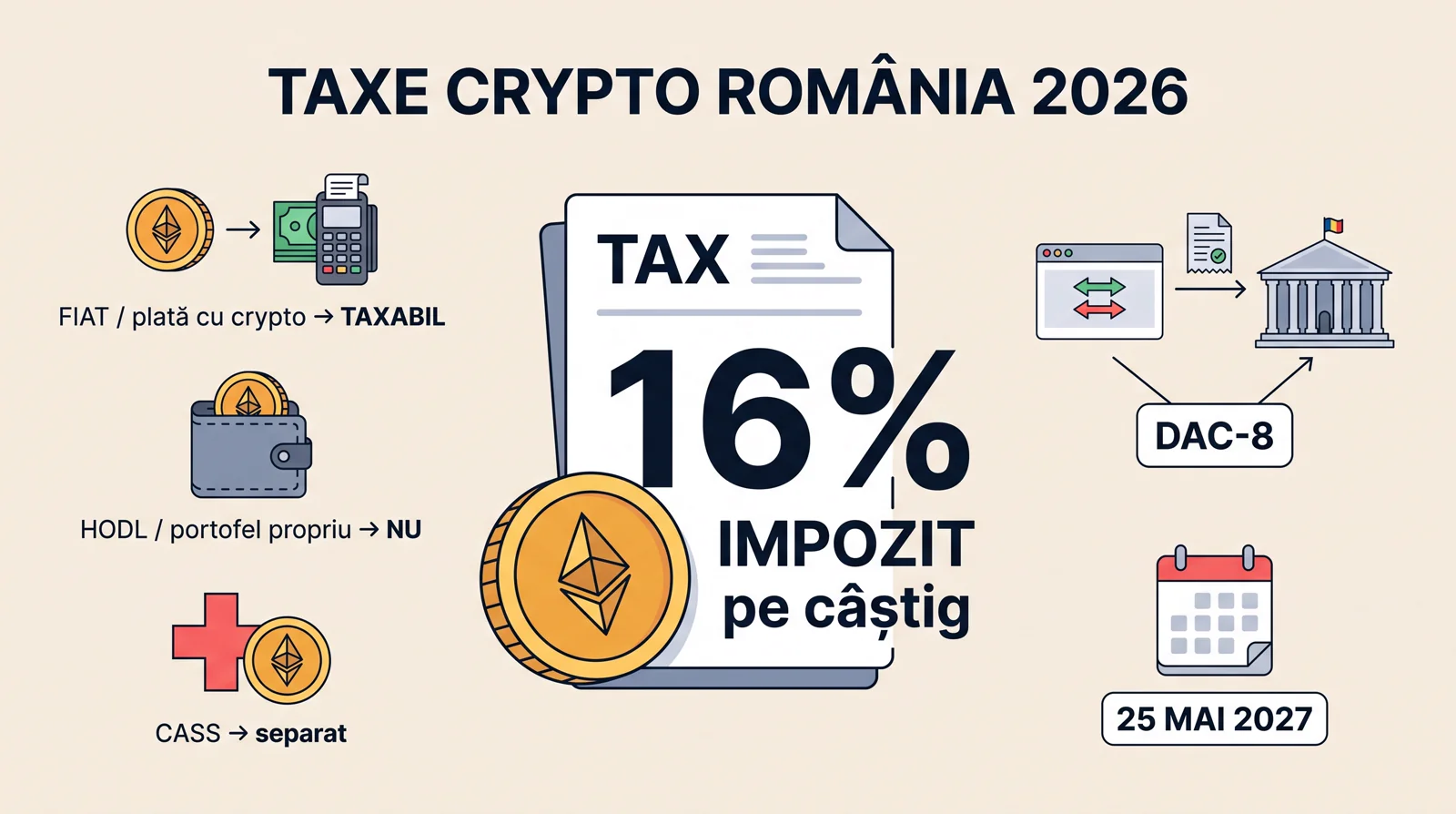
Crypto tax in Romania 2026: the complete guide
How much tax you pay on crypto gains in Romania: 16% from 2026, health contribution (CASS) in brackets, exemption thresholds, the 25 May deadline, DAC-8.
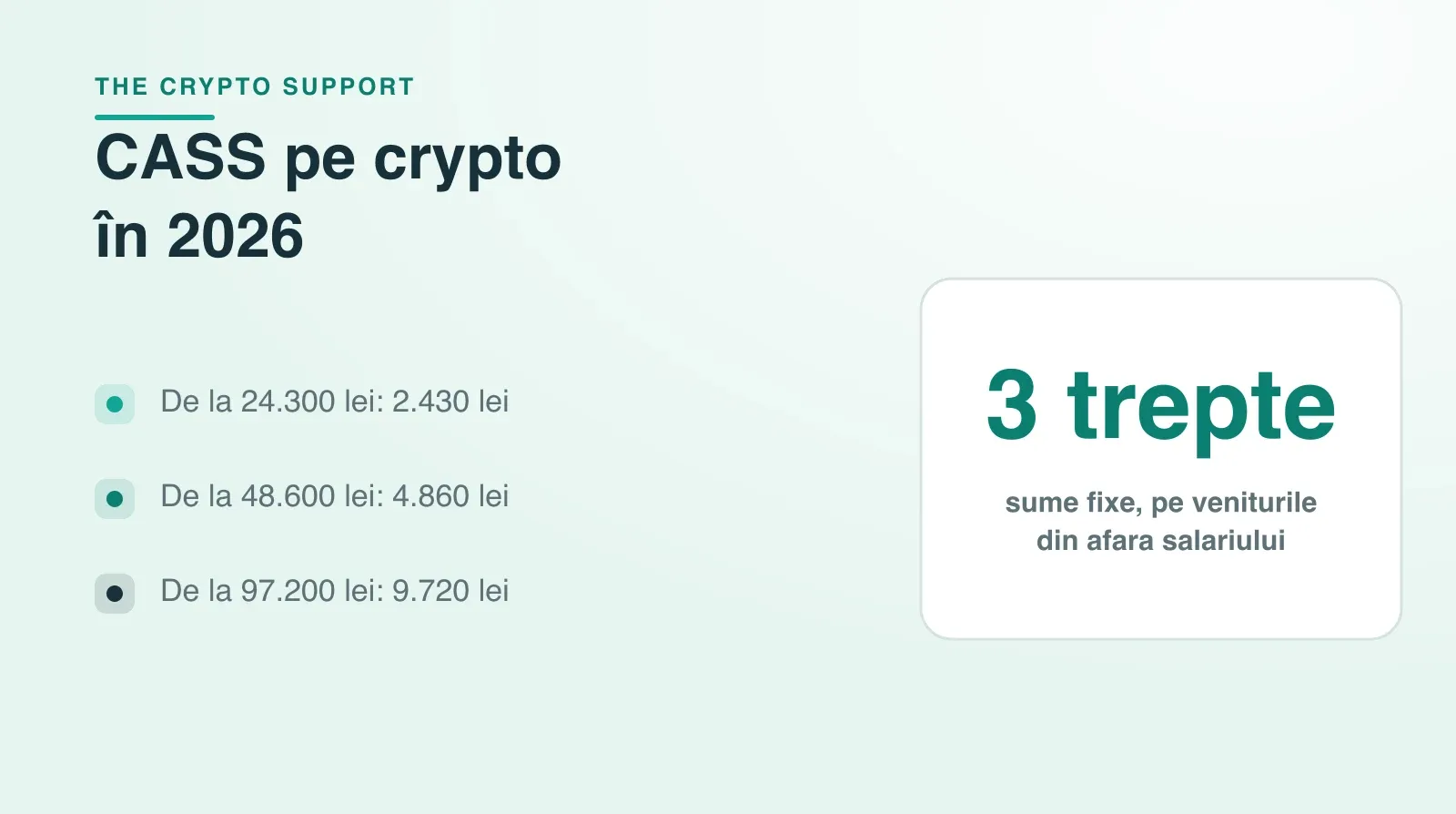
CASS on crypto in 2026: from what amount and how much you pay
Romania's health contribution (CASS) on crypto in 2026: from what amount it is due, what each bracket costs, what adds up and what a salary changes.
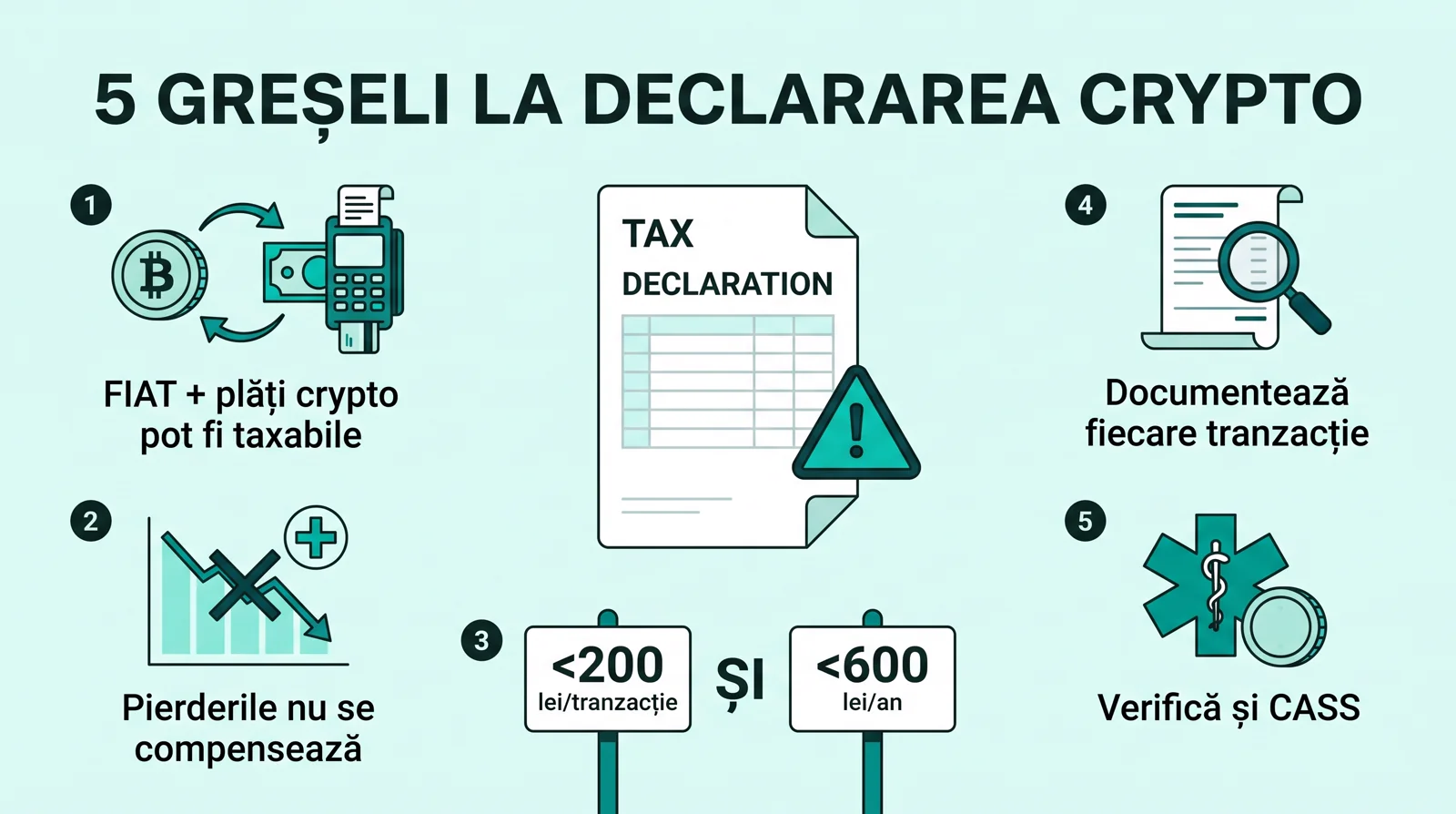
5 common mistakes when declaring crypto (and why they can cost you three times as much)
Didn’t sell for lei? Made a loss? Below 600 RON? The 5 mistakes that bring ANAF fines and penalties when declaring crypto, and how to avoid them.